magnetic tiles Actual test of adsorption differences among 3 materials: Is carpet the most prone to problems?

Magnetic tiles, as one of the most popular children’s building toys in recent years, occupy an important place in homes, early childhood education centers, and kindergartens due to their bright colors, lightweight operation, and almost limitless building possibilities. However, while playing with their children, more and more parents are beginning to notice a seemingly small but far-reaching issue: do different floor materials affect the adhesion and stability of magnetic tiles ? Why are children more likely to “collapse” their tiles when playing on carpets, while they seem to do so more smoothly on wooden floors or glass tabletops? These seemingly ordinary phenomena actually hide a combination of factors, including physical structure, force distribution, friction, and even visual stability.
This article focuses on the user experience of magnetic tiles , using three of the most common household materials—carpet, wood flooring, and glass tabletops—as a comparative basis to explore the reasons for differences in adsorption, their impact on children’s play experience and learning outcomes, and to explain the differences in structural stability formed on different surfaces through real-world scenario simulations. The article aims not only to help parents understand “why these differences exist” but also to provide educators and product designers with a more scientific and systematic perspective, enabling children to have a smoother construction experience and richer sensory development when using magnetic tiles .
Why do different materials affect magnetic tiles ? The physical logic behind adsorption and stability.
While the core structure of magnetic tiles relies on magnetic adhesion, the stability of an installation depends on much more than just the strength of the magnet. The performance of a magnetic tile structure in an environment is often determined by three key factors: flatness, friction, and weight distribution. Differences in adhesion caused by variations in ground materials actually stem from their respective effects on these three factors.
Carpets, with their soft, uneven, and varying thicknesses, make it difficult to provide a perfectly level and sturdy foundation for supporting structures. While magnetic tiles can adhere to each other, an unstable foundation can easily lead to overall tilting, localized deformation, or angular misalignment, causing the structure to collapse before it’s even built. For young children, this creates a sense of uncertainty from their environment, rather than a lack of their own building skills, which directly impacts their patience, concentration, and sense of security during play.
In contrast, wood flooring, with its solid surface and moderate friction, provides stable bottom friction while supporting magnetic tiles , making the structure more stable. Glass tabletops, on the other hand, have extremely high flatness but lower friction. While this is visually appealing, it may pose a risk of slippage when constructing taller structures. In other words, each of the three materials has its advantages and disadvantages, and their impact on the stability of magnetic tiles is not a matter of “good or bad,” but rather “different construction methods are suitable for different materials.”
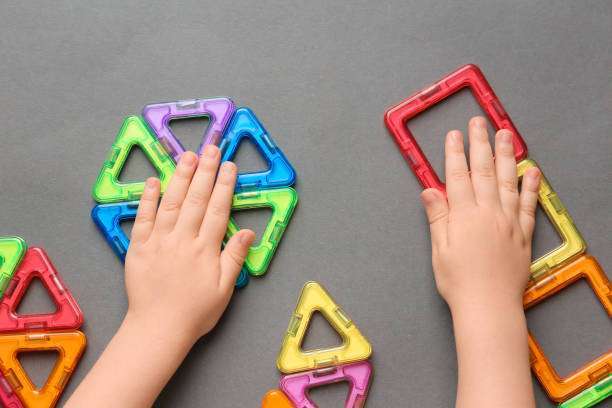
The Adhesion Challenges of Carpet Surfaces: The Root Causes of Insufficient Support, Distributed Pressure, and Instability
Of all materials, carpets are the most likely to confuse parents: Why does a small tower that can be built three stories high on the floor always collapse when moved to a carpet? Why do children show obvious frustration when using the same magnetic tiles on a carpet?
The root of the carpet problem lies in its softness. While the soft material seems protective, it has inherent flaws in supporting the structure. Carpet fibers compress with weight, and this uneven compression makes it difficult for the base of magnetic tiles to remain level. This tilt at the bottom of the structure creates a domino effect, causing uneven stress throughout the tower. As children continue building, even small deviations in the stress points are magnified into the swaying and toppling of the entire structure.
Carpets can also create additional visual illusions. Because of their uneven surface, children often have difficulty judging whether magnetic tiles are truly vertical. They often think they are “aligned” when in fact the structure is already slightly tilted, and this offset becomes more pronounced with height.
Furthermore, while the friction of a carpet may seem to “stabilize” the bottom, its insufficient support means that any slight lateral force from the hand can easily cause it to collapse. This often happens when young children are handling magnetic tiles , as their hand control is weaker, making it difficult for them to perform extremely gentle and precise placement movements.
The balanced advantage of wood flooring surfaces: optimal stability comes from flatness and moderate friction.
Wood flooring is the most common application for magnetic tiles and is also one of the most stable materials. This is mainly due to three factors: firm support, just the right amount of friction, and basic flatness. These three factors combined allow magnetic tile structures to build tall buildings based on even stress distribution, without affecting the overall structure due to loosening at the base.
Hardwood floors provide a stable, non-displaceable base, allowing magnetic tiles to maintain a stable orientation with each adhesion. The moderate friction of the wood floor also reduces slippage, preventing the structure from shifting due to minor vibrations. For children who enjoy building large structures like castles, bridges, and the Great Wall, hardwood floors offer the perfect platform to support their creativity.
More importantly, the stability of wood flooring allows children to maintain focus when recreating complex structures. They can learn about structural balance, angle adjustments, and the process of repeated attempts from collapses, without being forced to give up prematurely due to the limitations of the material itself. This material has a natural advantage in cultivating resilience, observation skills, and spatial thinking.
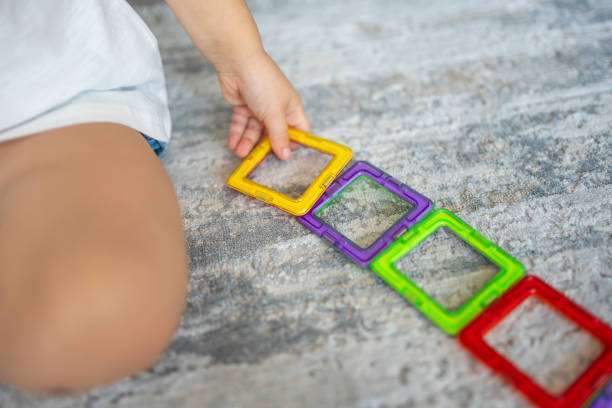
The high flatness of glass tabletops and the risk of slipping: a dual experience of stability and instability.
The biggest advantage of glass tabletops is their absolute flatness, which allows the light and shadow effects of magnetic tiles to be perfectly presented. Especially under sunlight, the colorful shadows cast by translucent magnetic tiles greatly enhance children’s visual engagement and aesthetic experience. However, this material also brings a significant problem: very low friction.
Because of their smooth surface, glass allows magnetic tiles to easily slip laterally. For low-rise structures, this slippage doesn’t significantly affect stability, but for tower-like structures requiring height support, it can inadvertently cause lateral displacement of the entire structure, leading to collapse. This is especially common when children are quickly building, making glass tabletops more suitable for planar composition games such as mosaic patterns, geometric shapes, and road designs.
Glass tabletops also offer a visual advantage: children can observe the interplay of light and shadow on the structure, helping them to more intuitively understand the changes in light as it passes through different colored tiles. This is uniquely valuable for enhancing visual perception, color recognition, and light awareness. However, adults still need to provide guidance on structural stability at appropriate times to avoid frustration caused by frequent collapses.
The psychological impact of three different materials on children’s play experience: stability, patience, and sense of accomplishment.
The differences in adhesion caused by different materials not only affect the construction results but also directly impact children’s psychological experience and even alter their play patterns. The instability of carpets can easily lead children to feel helpless, as if they can’t build anything stable, while the smooth experience of wooden floors makes them more willing to engage in complex constructions. The sliding nature of glass tabletops encourages children to control their strength and place objects more precisely, thus training their fine motor skills.
When children find structures stable, they are more willing to attempt to build taller, larger, and more complex structures, thus promoting independent exploration without supervision. However, when structures consistently collapse for no apparent reason, children gradually give up on challenges, switch to simpler modes, or even stop playing altogether. Therefore, the differences in experience brought about by material differences profoundly influence children’s perseverance, resilience, self-efficacy, and creativity.
How to ensure children have a good experience with different materials: Material selection and play guidance
While different materials present different challenges, parents and educators can adjust their approach to help children play successfully on any surface. For example, a hard mat can be used as a base on a carpet, a wooden floor is suitable for building tall structures, and a glass tabletop can be used to guide play with light and shadow and planar design. By matching play methods with materials, children can gain the richest experience from the advantages of each material.
Conclusion
Magnetic tiles are more than just toys; they are important mediums for children to explore the world, understand structures, and experience changes in light and shadow. The impact of different materials on their stability is not the issue, but rather an important educational opportunity for children to observe, compare, and adapt in different environments.
Parents can help their children have a smooth, enjoyable, and fulfilling experience on any material by understanding the reasons behind it and making appropriate adjustments to the play environment.