6 Forms of Magnetic Tiles as a Psychological Projection Tool: Understanding Hidden Signals in a Child’s Heart

I. The Psychological Projection Value of Magnetic Tiles
Magnetic tiles are not only creative building toys, but also a psychological projection tool that reflects a child’s inner world. In psychology, projection is a way of expressing inner emotions, cognitions, and conflicts through external media. Children, due to their limited language abilities, often find it difficult to directly describe their emotions, confusion, and stress. Magnetic tiles provide a safe and accessible channel for children to express their underlying psychological states through colors, shapes, and structures. Parents and educators can interpret a child’s underlying emotions and psychological needs by observing the building method, the chosen color combinations, the structural stability, and the rhythm of the activity.
magnetic tiles make the process of playing with them both visual and flexible, allowing for repeated adjustments, which provides rich information for psychological observation. Through different forms of building, children’s creativity, anxiety, desire for control, and cooperative tendencies can all be indirectly revealed. If parents can patiently observe and ask questions while accompanying their children during the building process, they will gain a deeper understanding of their children’s inner world, rather than just the superficial fun of completing a building task.
In practice, the value of magnetic tiles as a tool for psychological projection is also reflected in education and family interaction. Through assembling and observing, parents can not only discover potential emotional problems in their children, but also guide them in a safe environment, allowing children to achieve psychological growth by expressing themselves, releasing stress, and understanding rules. The uniqueness of this tool lies in the fact that through its concrete and visual operation, psychological projection becomes intuitive, identifiable, and guideable.
II. Form 1: Height and Layers Reflect the Desire for Control
children choose to build towers or multi-story structures using magnetic tiles , their behavior often reflects a need for control and mastery. Towers and multi-story structures require not only precise building skills but also stability and rhythm during construction. This behavior reflects children’s psychological tendency to seek order, master rules, and control their environment. The choice of height and the planning of levels can reveal a child’s self-positioning in their family and social environments, as well as their psychological strategies when facing uncertainty.
In practical observation, if children tend to build tall, narrow towers, it may mean they desire more attention and a voice in family or peer relationships. Children who choose short, stable structures may exhibit caution, dependency, or sensitivity to environmental changes. Parents can guide their children to understand the importance of planning and patience by discussing structural design and stability principles, while also observing their emotional reactions during disassembly or reconstruction to gain a more comprehensive understanding of their inner desire for control and emotional management abilities.
Furthermore, the act of building with varying heights and levels can be combined with task challenges. By guiding children to try different numbers of layers and structural complexities, their coping strategies and emotional reactions can be observed, providing specific references for psychological guidance and family education.
III. Form Two: Color Choice Reveals Emotional Tendencies
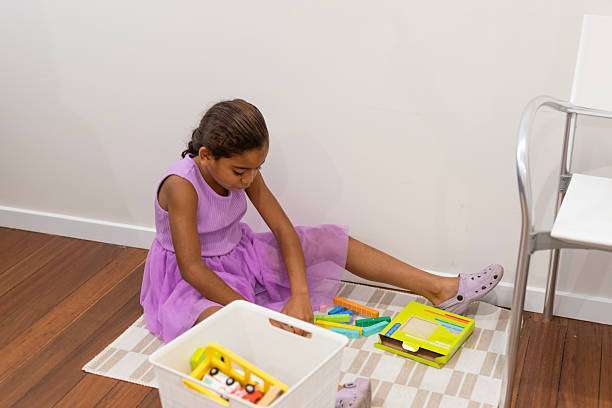
magnetic tiles are an important window into a child’s psychology. Different colors often correspond to different emotional states; for example, red may reflect passion or impulsiveness, blue may indicate calmness or introversion, and yellow may represent activity and a desire to explore. When children choose colors to build their tiles, it’s not entirely random; rather, they are subconsciously expressing their emotions or psychological needs through color.
During home observation, parents can record changes in their child’s color choices at different times and in different environments. If a child prefers a certain color under stress, it may reflect their emotional coping patterns. For example, consistently using dark or monochromatic color schemes may indicate recent low mood or anxiety in the child; while diverse and bright color combinations may reflect positive emotions or exploratory thinking. Through the projection of color, parents can not only understand their child’s current psychological state but also provide appropriate guidance during the puzzle-solving process, helping the child recognize and regulate their emotions.
Interpreting the psychology behind color choices requires a comprehensive assessment that considers the child’s actions, emotional responses, and verbal expressions. Relying solely on color may be insufficient, but combining it with the overall structure of the puzzle and behavioral patterns can lead to a more accurate psychological projection analysis, providing guidance for family education.
4. Format 3: Structural stability reflects the level of security and anxiety.
A child’s focus on structural stability when building with magnetic tiles is an important indicator of their sense of security and anxiety levels. A strong emphasis on stability, frequent adjustments to the structure, or repeated reinforcement of the base usually indicates sensitivity to environmental uncertainty or inner anxiety. Conversely, children who can accept structural collapse and try again tend to have greater psychological resilience and higher frustration tolerance.
When observing this phenomenon, parents can guide children to discuss the reasons for the structure’s stability, thus understanding their thought processes and emotional states. For example, when children frequently reinforce the structure to prevent collapse, parents can guide them to think about how to improve stability through reasonable planning, rather than simply relying on repetitive actions. Such guidance not only helps children understand cause and effect but also indirectly alleviates anxiety and improves problem-solving skills.
The value of structural stability observation lies in its provision of concrete behavioral manifestations of children facing challenges, coping with uncertainty, and regulating emotions. By analyzing building strategies, reinforcement behaviors, and adjustment frequencies, parents can gain a more precise understanding of their children’s security needs, providing practical evidence for psychological support and family communication.
V. Form Four: Repetition and Rule-Following Reflect a Sense of Order
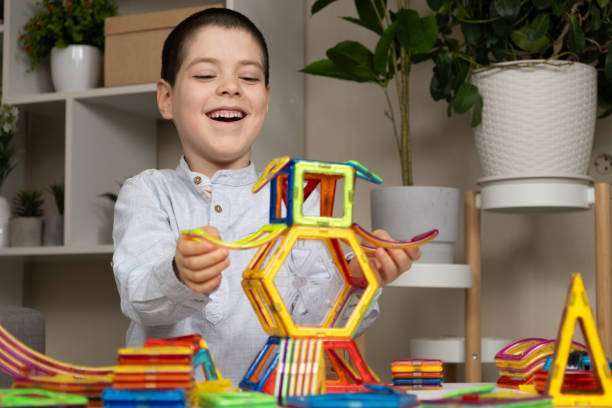
Some children exhibit highly repetitive actions or strictly follow established rules when building magnetic tiles . This behavior often reflects their emphasis on order and the stability of rules. Repeatedly building similar shapes, strictly symmetrical arrangements, or consistently adhering to a certain building logic are outward manifestations of children’s inner pursuit of control and security.
In family observation, if a child exhibits extreme repetition or overly rule-based behavior, it may indicate sensitivity to uncontrollable factors in life or learning, or a need for stability in certain emotional states. Parents can guide their children to try slight changes and innovations, observing their responses to understand their adaptability to new environments and changes. Through the repetition and rule-based operation of magnetic tiles , parents can identify the strength of their child’s sense of order and their psychological dependence on norms, providing a basis for adjusting their parenting methods.
Furthermore, repetitive and rule-following behaviors can be combined with team building activities, guiding children to understand the importance of flexibility and compromise through cooperation and discussion, thereby achieving comprehensive improvement in psychological development and social skills.
VI. Form Five: Dismantling and Reconstruction Reflect Frustration Tolerance
Disassembling and rebuilding are common activities in magnetic tile building, and their psychological value lies in revealing children’s resilience to setbacks and their problem-solving abilities. A child’s reaction to structural collapse or operational failure reflects their psychological resilience. Children who actively attempt to rebuild typically have strong resilience to setbacks and flexible thinking; while children who exhibit avoidance, anxiety, or strong emotional reactions may need more psychological support when facing failure and challenges.
When observing a child’s disassembly and reconstruction behavior, parents should pay attention to the child’s pace, emotional expression, and problem-solving strategies. For example, after a breakdown, is the child willing to analyze the cause, adjust the plan, and try again, or does the child need external guidance to continue? This behavioral information provides parents with direct evidence of their child’s psychological resilience, creativity, and emotional regulation. By consciously setting disassembly and reconstruction tasks, parents can help children practice psychological resilience and cultivate problem-solving thinking patterns.
The educational value of deconstruction and reconstruction lies not only in psychological projection, but also in cultivating patience, creativity and teamwork in practical operation, enabling children to continuously practice coping with setbacks and self-regulation in a safe environment.
VII. Format Six: Collaborative Assembly Reflects Social Skills and Communication Habits
magnetic tiles can serve as an important window into children’s social skills and communication habits. In collaborative building tasks, children’s participation methods, listening and expression abilities, decision-making and negotiation strategies, and their acceptance of others’ opinions can reflect their interaction patterns in family and social environments. Collaborative building behavior not only reveals children’s social tendencies but also provides parents with practical scenarios for education and guidance.
In practice, parents can set up collaborative tower, light and shadow maze, or bridge building tasks using magnetic tiles and observe their children’s performance in a team. Children who actively participate, divide tasks reasonably, listen to others’ opinions, and offer suggestions usually have strong social skills and mature communication skills; while children who are overly controlling, lack cooperation, or react emotionally may need guidance to cultivate their cooperative awareness and communication skills. Magnetic tiles , as a tool, provide a low-risk, fun, and engaging learning environment for families, allowing children to develop social skills through play, while parents can provide timely psychological support and behavioral guidance.
VIII. Practical Guidance and Family Observation Techniques
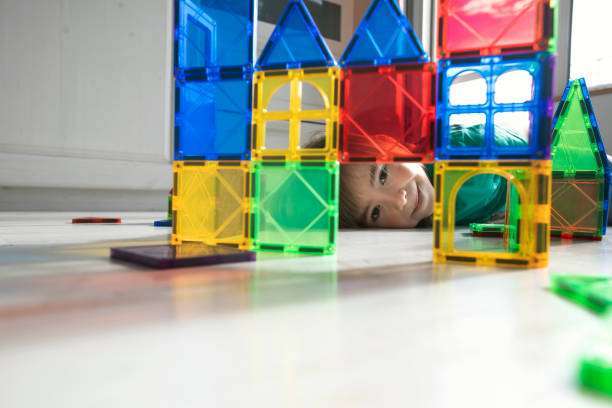
In home practice, using magnetic tiles for psychological projection observation requires parents to be patient, respect children’s freedom of operation, and carefully record their behavior and emotional reactions. Various building tasks can be set up, such as building towers, constructing bridges, creating light and shadow effects, and collaborative building, to observe children’s choices and operational methods in different tasks. Simultaneously, through appropriate questioning and discussion, children can be guided to express their design concepts and operational ideas, further understanding their inner motivations and psychological needs.
Parents should avoid directly interfering with the results of activities, and instead focus on the child’s behavioral patterns, emotional changes, and problem-solving methods. Through long-term observation, combined with considerations of color selection, structural design, operational rhythm, and cooperative performance, a comprehensive understanding of the child’s psychological characteristics can be formed, providing a scientific basis for family education and psychological guidance.
In addition, magnetic tiles for psychological projection observation can be integrated with educational activities, such as in learning tasks, family discussions, and creative expression, to enhance children’s cognition and creativity, as well as strengthen communication and understanding among family members.
IX. Conclusion
Magnetic tiles are not only creative building toys, but also a tool for psychological projection. Through six forms—height and layering, color selection, structural stability, repetition and rule-following, disassembly and reconstruction, and cooperative building—they can reflect children’s emotional states, psychological traits, and social skills. Parents, through observation and guidance, can not only understand their children’s hidden inner signals, but also cultivate their children’s focus, creativity, emotional regulation, and cooperative awareness through hands-on activities. Incorporating magnetic tiles into family education practices provides a visual, hands-on, and engaging tool for psychological observation and education. magnetic tilesThis makes family interactions more profound and warmer.
FAQ
Q1: Which age group is
magnetic tiles psychological projection observation suitable for? It is suitable for children from preschool to lower elementary school. Through operation and observation, you can understand the child’s emotional state, psychological characteristics and social skills.
Q2: How should parents avoid interfering with their child’s natural behavior during observation?
Maintain patience and low intervention, avoid directly evaluating the assembly results, and understand the child’s thought process and emotions through recording and asking questions, rather than changing the way the child operates.
Q3: How can the observation results of magnetic tiles be applied to family education?
By analyzing color selection, structural stability, operation rhythm, repeatability and cooperative performance, parents can adjust their communication methods, educational strategies and emotional guidance methods according to their children’s psychological needs.