3 mechanical tests on magnetic tiles : Which splicing angle is the most secure?

Magnetic tiles, a popular creative building toy loved by children and parents in recent years, not only occupy an important place in early childhood education, kindergarten classrooms, and family games, but are also gradually becoming a powerful tool for children’s scientific enlightenment. Many parents and teachers are surprised to find that children show a strong curiosity about concepts such as angle, structural stability, center of gravity, and height when playing with magnetic tiles .
This curiosity is precisely the best starting point for learning physical and mechanical concepts. Magnetic tiles are essentially a kind of visual structural building material. Every adsorption, collapse, stabilization, bending, and support corresponds to real mechanical phenomena, which makes magnetic tiles not only a play material, but also an excellent medium for children to understand the physical world.
In children’s science education, the most challenging aspect isn’t getting children to memorize facts, but rather guiding them to observe through action, verify through play, and reflect on failures. This is something traditional teaching methods struggle to achieve, but magnetic tiles can easily do.
Through simple assembly, children can gradually understand why triangles are more stable than squares, why angled supports can distribute force, and why overstretching a structure can lead to its collapse. These introductory processes aren’t the result of deliberate adult instruction, but rather genuine feedback children receive through repeated practice—the most natural and effective way to learn mechanics.
This article will delve into three mechanics experiments centered on “angular stability,” observing children’s actual actions to summarize which splicing methods are the most stable and which structures are most prone to collapse. It will also analyze the underlying mechanical principles, helping parents, teachers, and readers interested in early childhood science education to systematically understand the mechanical mysteries of magnetic tiles .
The article unfolds from both children’s and adults’ perspectives, providing detailed breakdowns of the actions and in-depth explanations of mechanical concepts, enabling readers to truly understand why different angles result in such significant differences in stability.
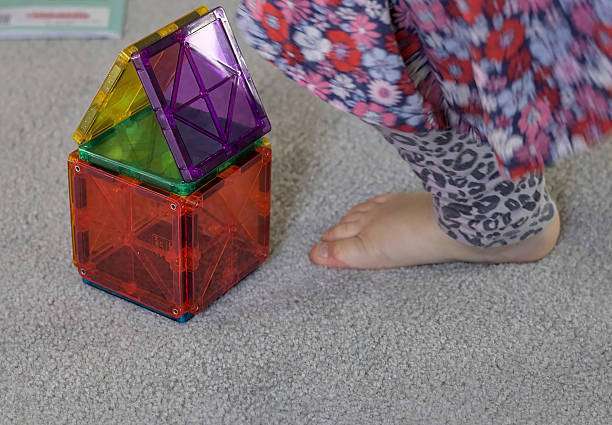
I. The illusion of stability and the real risks of right-angle splicing: why does it seem sturdy but is most prone to collapse?
In most children’s magnetic tile building, right angles are the most common way to connect tiles, such as building a wall, creating a frame, or constructing the supporting structure of a house. Children often assume that right angles are the most stable because many objects in life, such as desks, bed frames, and cabinets, have right angles.
However, the right angles in magnetic tiles are not exactly the same as those in furniture. Furniture is secured internally with screws, wooden dowels, or metal parts, while magnetic tiles are held together by magnetic force. Furthermore, the magnetic force is planar rather than three-dimensional, so right angle connections in magnetic tiles actually have a characteristic of being “visually stable but structurally fragile.”
When children build right-angle structures, they often start by joining two squares or rectangles, spreading them out at a 90-degree angle. This connection seems quite stable initially, but once the child tries to add more structures on top, or pushes, rotates, or applies gentle force from the side, the right-angle connection often loosens or even collapses. The root cause of this phenomenon is that right-angle connections cannot distribute external forces. When the structure is subjected to external forces, the right angle becomes a significant stress point. This point cannot effectively resist torsional forces, so the seemingly stable right angle is actually very easy to deform under external forces.
Through repeated attempts, children will feel this looseness with their hands. They will notice that right-angled connections “sway” from side to side when gently shaken, and this swaying is the most obvious feedback of instability. Right-angled structures lack sufficient lateral support, causing almost all the force to be concentrated at the connection point.
Any unplanned movement can cause magnetic tiles to disintegrate. Many children often encounter this situation when building castles or houses: a seemingly solid wall suddenly breaks after adding another layer. After rebuilding magnetic tiles and experiencing repeated failures, they will naturally realize that right angles are not the most stable structure.
For parents and teachers, this is an excellent opportunity to introduce mechanics to children. They can guide children to think about why right angles are prone to collapsing and why they need extra support. However, the guidance shouldn’t provide answers, but rather use language to encourage observation.
For example, let children gently push the structure, try applying force from different directions, and experiment with supporting corners using magnetic tiles of different shapes . Through these activities, children will gradually discover that right angles are unstable when used alone, laying the foundation for subsequent experiments on stable triangular structures.
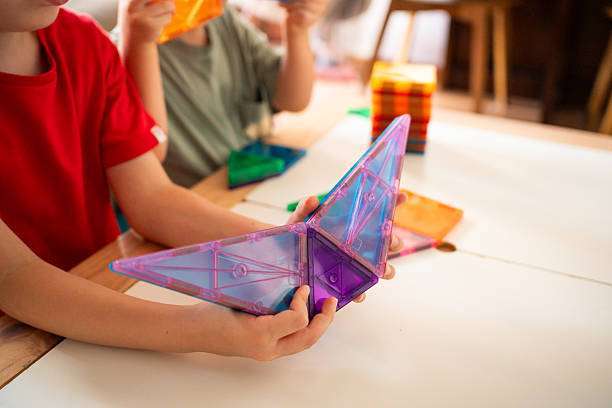
II. The inherent stability of triangular angles: why are triangles more stable the closer they are to an equilateral triangle?
Triangles are the most stable basic unit in engineering structures, and this principle also applies to construction experiments with magnetic tiles . After playing with magnetic tiles for a while, many children will start trying to assemble them using triangles. When they assemble three triangles into a stable angle, they will be surprised to find that this structure is less prone to wobbling than a right-angled structure. More importantly, children don’t need adult explanations; they can intuitively feel the stability of the triangular structure simply by experiencing it a few times.
The stability of a triangle comes from its fixed three sides. When any vertex is subjected to an external force, the force is transmitted throughout the entire triangle structure, rather than being concentrated at a single point. Therefore, triangles have the ability to disperse forces, making them widely used in architectural engineering, bridge structures, and mechanical devices. What the child observed in the magnetic tiles experiment is a miniature version of this engineering principle.
If children use equilateral triangle magnetic tiles to build, they will find the structure is more compact because the three angles of an equilateral triangle are consistent, resulting in a more even distribution of force. This uniformity gives children a noticeable sense of stability when pushing, lifting, or rotating the structure. When children use acute or obtuse triangle magnetic tiles , they will also notice the differences caused by the different angles. Acute triangles make the structure more “closed” in 3D construction, while obtuse triangles are more likely to cause the whole structure to wobble from side to side.
In this experiment, children observed whether the connections between magnetic tiles were loose, whether their creations wobbled, and whether the angles remained fixed, thus understanding the stability advantages of triangular structures. They spontaneously incorporated triangles as supports into larger creations, such as arches in castles, bridge supports, and the base of towers. Children even proactively added triangles to reinforce flawed right-angled structures, demonstrating that they had grasped the significance of triangular stability through action.
At this stage, parents or teachers can further deepen children’s scientific thinking by asking questions. For example, observe whether two triangles are more stable when stacked, try changing the angle to see if it affects the stability of the structure, or apply the triangular structure of magnetic tiles to larger works. These explorations will help children begin to understand the physical law that “the closer the angle is to equilibrium, the more stable the structure.” This understanding does not require abstract reasoning but is naturally formed through countless hands-on experiences, making it the most precious way to introduce science to children.
III. Why do angled supports keep tall towers from collapsing? How do structures distribute their center of gravity through angle?
When building taller structures with magnetic tiles , many children encounter the same problem: the taller the structure, the more noticeable the wobbling, often leading to the collapse of the entire structure when the last tile is placed. This phenomenon is related to the center of gravity and support; taller structures require more slopes to distribute the pressure from below. Magnetic tiles are particularly suitable for conducting angled support experiments because their magnetic tile adhesion allows children to visually see how the angled structure contributes to the support.
When children try to support a structure using two square magnetic tiles at an angle, they will find that this angle resists swaying more effectively than a right angle. As they adjust the angle of the magnetic tiles , they will see that certain angles significantly enhance the stability of the structure , such as slightly open obtuse angles or slightly tapered acute angles.
These changes directly affect the stress distribution. By pushing the structure, tapping its sides, or gently shaking the tower, children can observe the different behaviors resulting from different angles, which is a crucial part of their mechanical learning experience.
Angled bracing is essentially a way to distribute gravity and lateral forces. In the real world, many large engineering structures use this method, such as the cable-stayed sections of bridges, the triangular trusses of building roofs, and the sloping supports of tents. What children see in their magnetic tiles experiments are miniature versions of these engineering structures.
When the angle is appropriate and the bracing is just right, the tower’s center of gravity is more effectively distributed to the base, significantly reducing swaying. When the angle is too large or too small, the support strength decreases, and the structure becomes more fragile.
What’s most interesting is that children don’t need to understand technical terms like center of gravity, support force, and component forces. They simply need to repeatedly manipulate the puzzle pieces and contemplate whether “this is more stable” or “that will topple over,” and they’re already engaging in important scientific thinking. Adults can help children observe changes in angles at this stage. For example, they can suggest using transparent puzzle pieces to observe angles and gently pressing different parts of the structure to feel whether the angles can withstand force. Through these processes, children gradually learn to judge which angles reduce tilting and which structures allow their work to maintain greater stability.
Applying angled supports to larger projects marks a deepening of children’s understanding of mechanics. When children can proactively add two angled support points on either side of a large tower structure to prevent it from swaying, they have actually grasped a core concept in structural engineering. This knowledge doesn’t come from abstract classroom lectures, but from hands-on experiments and experiences—the most natural and solid way for children to learn.
Conclusion
Magnetic tiles, as a highly open-ended construction toy, provide children with an excellent platform to observe mechanics, understand structures, and experience differences in stability. Through three classic angle experiments—right-angle splicing, triangular stability, and oblique support—children can naturally encounter core concepts of structural engineering and physical mechanics in a safe, free, and stress-free environment. They cultivate a spirit of exploration, logical analysis skills, and hands-on problem-solving abilities through a cycle of failure and success.
These mechanics experiments not only enhance children’s scientific thinking but also strengthen their patience, focus, perseverance, and reflective abilities. More importantly, magnetic tiles allow children to connect with the physical world in a fun and immersive way. This kind of scientific experience gained through everyday play is far more profound than abstract knowledge and will play a greater role in future learning.