
Among numerous educational toys for children, magnetic tiles have won the hearts of countless parents and children with their bright colors, varied shapes, and rich gameplay. From two-dimensional shapes to three-dimensional buildings, they can realize almost all of a child’s fantasies. However, many beginners encounter similar problems—the completed works are often unstable, the magnetic tiles easily slip off, and even the attraction is strong in some places but weak in others.
These seemingly minor problems often dampen a child’s enthusiasm, even leading them to mistakenly believe that they are “not smart enough” or “can’t play well.” In fact, these problems are caused by factors such as the structure of the magnetic tiles, the distribution of the magnets, and the method of operation. To truly help children grasp the charm of magnetic tiles, it is necessary to find the answers to these common misconceptions.
I. The root cause of instability: structural support and magnetic force direction
Unstable installation is a common problem for magnetic tile beginners. Many parents’ first reaction is that “the magnetism is not strong enough,” but in reality, the core reason for instability often lies in unreasonable structural design and incorrect splicing direction.
Magnetic tiles appear symmetrical; the orientation of the magnets inside each tile is fixed. Magnets have positive and negative poles; if the magnetic poles of two tiles are aligned during assembly, they will repel each other and fail to attract. Children often rely on intuition when assembling them, and if they don’t pay attention to the magnet orientation, the structure may become loose or even collapse.
Furthermore, the center of gravity of a structure is also a key factor in determining its stability. When children are building towers or castles, if the base area is too small, the support is uneven, or the layers are stacked too high, the center of gravity of the entire creation will continuously shift upwards, making it prone to tipping over with the slightest touch.
The correct approach is to start building from the bottom, ensuring the stability and symmetry of the foundation, and then gradually expand upwards. Parents can guide children to try structural designs with a “square base + pyramid top,” as this configuration is easier to maintain balance.
Sometimes, children get so fast that they forget to align each magnetic piece. The magnetic pieces need to fit precisely; even a slight angular misalignment will weaken the magnetism. Parents can teach their children a “slow assembly method”—let the magnetic pieces attract naturally, then gently press the edges together with your fingertips. This way, each piece will be firmly in place.
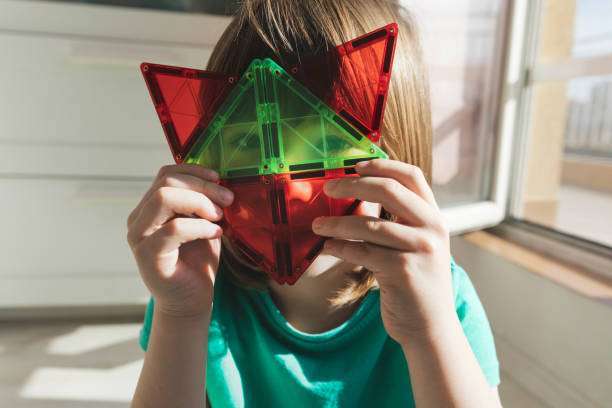
II. Frequent slippage issues: Insufficient friction and surface angle
Another common phenomenon in building is “slippage.” Many children build a wall or a roof, only to find the structure begins to slip after a few seconds, eventually causing the entire creation to collapse. The root cause of this problem lies in the imbalance between friction and magnetism.
Magnetic tiles use a smooth plastic shell. While this material is aesthetically pleasing and easy to clean, it also means lower friction. When two tiles are joined at an angle, gravity can cause the upper tile to slide along the seam. If the bottom support is insufficient or the angle is too large, even strong magnets cannot prevent this sliding tendency.
Furthermore, the operating environment also affects stability. Assembling on overly smooth surfaces like tabletops, floors, or glass reduces the friction of the underlying magnetic tiles, making the entire piece more prone to slipping. A simple improvement is to assemble it on a cloth mat or non-slip mat, which significantly enhances the structure’s stability.
Weather and temperature are also influencing factors. Magnetic tiles are mostly made of ABS plastic, which expands slightly when heated, especially in direct sunlight. The distance between the magnet and the outer shell may increase, thus weakening the attraction. Therefore, high-temperature environments should be avoided when assembling them.
III. The Truth Behind Uneven Attraction: Magnet Orientation and Manufacturing Differences
“Why do some magnets stick together so tightly, while others fall off with the slightest touch?” This is a common question asked by parents. Uneven magnetic force is not uncommon, and it often stems from differences in the orientation of the magnets, the strength of the magnetic force, and the precision of their manufacturing.
High-quality magnetic tiles undergo rigorous magnetic polarity calibration at the factory to ensure that each magnet is aligned, guaranteeing effective adhesion during installation. However, counterfeit or low-quality products may have unstable magnet alignment or even reverse polarity. This can cause some tiles to repel each other, preventing the tiles from fitting together properly.
After prolonged use, magnets may experience slight demagnetization or displacement. When a magnetic sheet is dropped or squeezed, the internal magnets may move slightly, reducing the attractive force. Parents can use a simple test to determine if the magnetic sheets are intact: gently bring two magnetic sheets close together and slowly rotate them. If there are obvious “attraction points” and “repulsion points,” it means the magnets are aligned. If they cannot attract at any angle, it means the internal orientation of the magnets is off, and they need to be replaced.
Furthermore, mixing magnetic tiles from different brands can lead to uneven magnetic force. Different brands have variations in magnet polarity, magnetic strength, and shell thickness, so even tiles of the same size may not be perfectly compatible. To ensure a smooth gaming experience, parents are advised to choose magnetic tile sets from the same brand or series for their children.
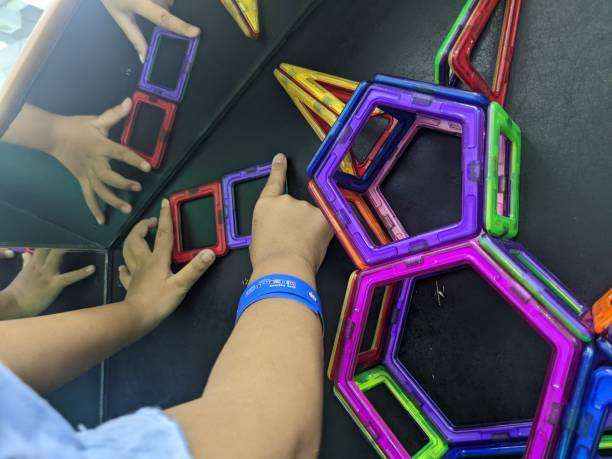
IV. Material and Brand Differences: Quality Determines Stability
The magnetic tiles market is vast, but product quality varies greatly. Many parents focus only on design and price when purchasing, neglecting the crucial differences in materials and magnet grade. High-quality magnetic tiles are typically made of environmentally friendly ABS plastic with a frosted surface, making them safe and odorless and enhancing friction to prevent slipping. In contrast, some cheap magnetic tiles use inferior plastic, which feels smooth but lacks toughness and is prone to cracking or deformation over time.
The material of the magnets is also crucial. High-quality magnetic tiles use neodymium iron boron magnets, which have strong attraction and are resistant to demagnetization, maintaining stable attraction over a long period. Ordinary ferromagnets, on the other hand, are prone to demagnetization, resulting in a significant decrease in attraction. When children assemble them, even slight force can cause the structure to fall apart.
The differences in craftsmanship between brands are also reflected in the precision of packaging. High-end brands use ultrasonic welding technology for magnet packaging, ensuring that the internal magnets are fixed and uniformly positioned; low-quality products may simply be glued on, and after repeated drops, the magnets may loosen or even fall off, affecting not only the gameplay but also posing a safety hazard.
Therefore, when purchasing magnetic tiles , parents should prioritize brands with safety certifications. Checking for international certification marks such as CE and CPC on the packaging can ensure that the product meets children’s toy safety standards.
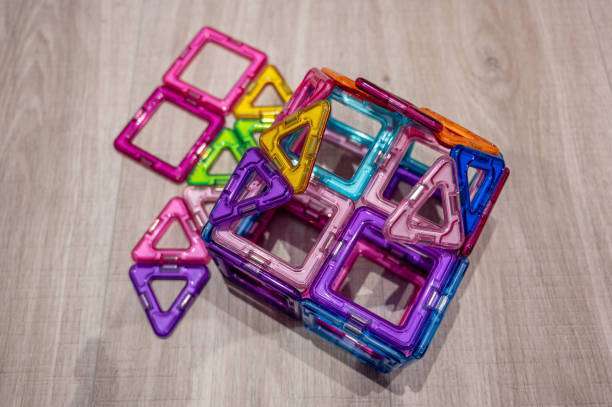
V. How to go from “unstable assembly” to “skillful building”: guidance and habit cultivation
Once parents understand the principles above, the most important thing is to guide their children to gradually improve through play. The process of building is itself a form of learning; children experience physical laws and structural logic through repeated failures and successes. Parents should not rush to correct mistakes but rather guide their children’s thinking by asking questions.
For example, when a tower-shaped structure collapses, you can ask, “Would it be more stable if we added a few more blocks at the bottom?” or “Is it because the two sides are not the same height?” Such questions can stimulate children’s interest in active exploration and help them find solutions from their mistakes.
At the same time, challenging tasks can be introduced, such as “building a bridge that can support a toy car” or “assembling a three-story castle.” These goals can help children learn balance, support, and structural optimization skills, as well as cultivate their focus and patience.
For parents, staying involved is equally important. Many children feel frustrated after a single failure during the building process, but parental encouragement can often help them get back on their feet. Magnetic tiles are not just toys; they are also a vehicle for cultivating logical thinking, spatial imagination, and hands-on skills.
VI. Conclusion
magnetic tiles lies in their fusion of science and art. Problems such as instability, slippage, and uneven attraction, while seemingly frustrating, are actually the starting point for children to understand the physical world. Through observation, analysis, and improvement, they can gradually grasp the principles of magnetism, gravity, and balance.
When children learn to find the reasons for their failures and summarize their experiences from their attempts, every stained-glass castle and every magnetic bridge becomes a mark of their thinking and growth. With the right methods and scientific guidance, magnetic tiles can become the best partner for children exploring the world.