
From basics to creativity: Unlocking the door to imaginative building.
Magnetic tiles are more than just toys; they are a bridge to creativity. Their transparent sheets, vibrant colors, and strong magnetic structure create a space full of possibilities for children and parents alike. Their charm lies in the lack of standard answers; each assembly can be a new discovery. Whether it’s a 3-year-old’s early development or a child around 8 years old beginning to develop structural thinking, magnetic tiles can uniquely stimulate their desire to explore.
The core of creative play is not about pursuing complexity but about allowing children to naturally combine life with science and art with logic through hands-on activities and imagination. The following ten play methods demonstrate, from the perspectives of educational psychology and family interaction, how magnetic tiles can become the best medium for “hands-on thinking.”
Castle of Light and Shadow: Let Sunlight Be the Architect
When magnetic tiles meet sunlight, the entire room transforms into a laboratory. Children can build a colorful castle by the window, and as sunlight shines through the different colored tiles, dappled light and shadow appear on the floor. Parents can guide their children to observe how light penetrates, refracts, and overlaps, offering not only an aesthetic experience but also an introduction to optics. Through this play, children can intuitively understand the natural laws governing transparency and translucency, as well as color mixing.
Transportation World: Build Your Own Mini City
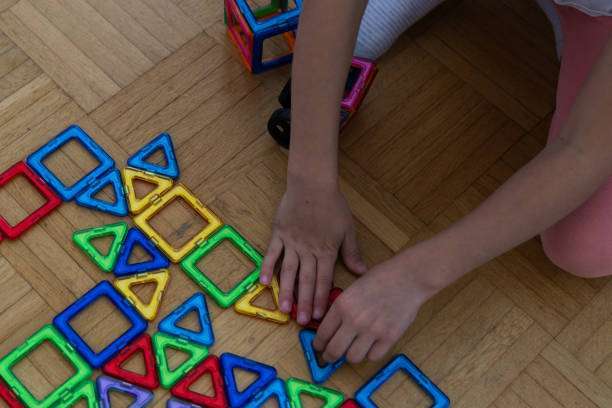
Using square and triangular magnetic tiles, children can build roads, bridges, tunnels, and even subway tracks. Letting toy cars travel through this magnetic tile city helps them understand “spatial continuity” and “functional zoning” through play. When planning roads, they learn how to adjust proportions and directions, cultivating basic design logic and engineering awareness.
What’s even more interesting is that different colors can be used to represent different functional areas—blue for the river, green for the park, and red for the residential area. This small town is both a playground and a training ground for children’s spatial thinking.
Colorful Geometric Art: An Exploration from Shapes to Patterns
magnetic tiles is their diverse shapes. Combinations of squares, triangles, trapezoids, and hexagons can create an endless variety of geometric patterns. Children can create flowers, butterflies, stars, or abstract patterns on a flat surface, and in this process, they will spontaneously experience concepts such as symmetry, balance, and proportion.
If you place a blank sheet of paper as a base and let sunlight shine on the assembled pattern, you’ll see the effect of overlapping shadows and colored lights. Children can trace these shadows with paintbrushes and then fill in the colors—a simple way to extend assembling into artistic creation.
Building a tower: a challenge of balance and center of gravity
Almost every child wants to know how tall a tower they can build. While tower building may seem simple, it’s an excellent way to train hand-eye coordination and physical awareness. During the building process, children gradually discover that the larger the base, the more stable the tower; and the heavier the upper levels, the easier it is to tip over. These small experiments help them naturally understand physical principles such as “center of gravity,” “support,” and “balance.”
When the tower collapses, parents should not rush to intervene but rather guide their children to think, “Why did it collapse?” or “Would it be more stable if it were shaped differently?” This question-based learning is more effective in stimulating the spirit of exploration than direct teaching.

Tunnel of Light: A Wonderful Fusion of Senses and Space
Magnetic tiles can be used to create a transparent “tunnel.” By connecting multiple tiles to form a long strip and then shining a flashlight inside, children can see how light passes through, reflects, and changes color. This play method not only has a strong visual impact but also helps them develop the concept of “spatial extension.”
If conducted in the dark, children can also experience the changing “path of light.” When they discover that the color and brightness of light differ at different angles, they are conducting a small science experiment.
Animal shapes: Giving life to puzzles
Children’s creativity often stems from imitation. With magnetic tiles, they can try to create various animal shapes: cats, dinosaurs, whales, or birds. During the building process, they understand the correspondence between shapes and body structures, such as using triangles to represent the spread of wings and squares to represent the stability of the body.
This concrete construction can improve children’s visual thinking skills. More importantly, parents can tell “animal stories” with their children, combining building with language expression, making the game more narrative.
Transparent Maze: A Dual Test of Logic and Direction
Using magnetic tiles is a highly challenging activity. Children need to consider the logical distribution of passages, corners, and exits while ensuring the structure is visually clear. This activity allows them to develop logical reasoning skills through trial and error.
Parents can roll a small ball through the maze, allowing children to observe the path and optimize their design. This interactive process not only develops spatial planning skills but also cultivates patience and focus in problem-solving.
3D Letters and Numbers: Learning to Read and Count Through Building
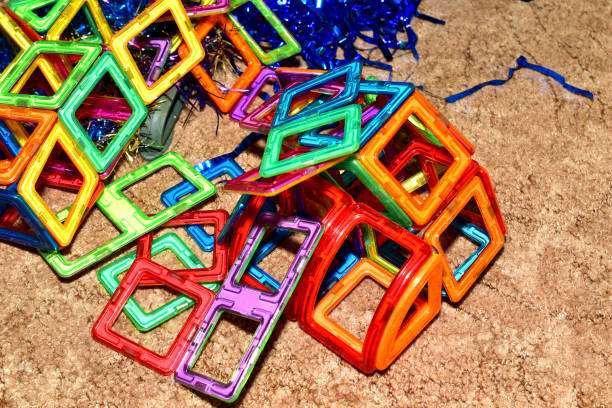
Combining learning with play is another educational potential of magnetic tiles. Parents can guide children to use the magnetic tiles to create letters or numbers, reinforcing visual memory through the act of building. For example, using triangles to create the letter A or squares to form the number 4. This is more interactive than writing on paper, and children are more likely to develop shape concepts this way.
This type of play is especially helpful for young children. Building makes abstract symbols concrete and visible, allowing the learning process to be more naturally integrated into the sensory experience.
Light and Shadow Puzzle Wall: Creating Your Own Art Exhibition
By attaching magnetic tiles to metal or magnetic walls, a “light and shadow puzzle wall” can be created. Children can use the wall to create patterns and shapes and tell stories. With the help of lighting, the entire space will present a dreamlike color transformation.
This three-dimensional puzzle-building method expands the boundaries of traditional two-dimensional puzzles, transforming children from “tabletop players” into “spatial artists.” When they adjust the angles or colors, they are actually experiencing the relationship between light and shadow and perspective, an experience that will greatly benefit their future painting and spatial composition skills.
Parent-child collaborative construction: jointly completing a “great project”
The last way to play is the most heartwarming. Magnetic tiles aren’t just for children; they can also become a bridge for family communication. Parents and children can set goals together—such as building a bridge, a house, or a zoo. During this collaborative process, children learn division of labor and teamwork while also observing adults’ logical thinking and problem-solving methods.
The moment the artwork is completed is not only the birth of a structure but also the deepening of the parent-child relationship. The child will feel the joy of being recognized and involved, and this emotional experience is the nourishment for the growth of creativity.
Conclusion
Magnetic tiles lie not in the complexity of the structures they can create, but in how they make creativity a part of life. They teach children how to observe, experiment, imagine, and improve—abilities that are the most valuable qualities for future learning and life.
Amidst the colorful light and shadow, children learn balance, logic, and expression; through repeated building and collapsing, they understand the relationship between science and art. Magnetic tiles are not just toys but a language, a way for children to communicate with the world. Each tile is a fragment of childhood wisdom, pieced together to illuminate the map of growth.