Magnetic Tiles: 3 Scientific Shocks—Spatial Perception Can Be Reshaped by Toys

From Toys to Cognitive Tools: The Scientific Potential of Magnetic Tiles
Originally designed as a colorful building toy, magnetic tiles’ transparent material and magnetic structure have captivated countless children. However, a growing body of educational psychology research shows that their role extends far beyond mere entertainment. Magnetic tiles are becoming a “spatial cognition trainer,” helping children aged 3 to 8 build spatial awareness, understand three-dimensional structures, and perceive changes in light and shadow through play. This transformation from “play” to “learning” precisely reveals the core concept of toy pedagogy—children understand the world through manipulating it.
When children pick up a magnetic tile, they are not only assembling shapes but also conducting a miniature cognitive experiment. The transparent tiles allow them to observe the process of light passing through and colors overlapping, while the magnetic attraction requires them to constantly adjust the angle and alignment. These seemingly simple actions activate areas of the child’s brain related to spatial thinking, hand-eye coordination, and visual judgment, making it a natural and effective way to provide early childhood education.
The budding of spatial perception: 3-8 years old is the critical window period
In children’s cognitive development, the period from 3 to 8 years old is a golden age for the rapid formation of spatial perception. During this stage, children are learning to understand abstract spatial concepts such as “up and down,” “near and far,” and “front and back.” Traditional flat picture books or paper teaching aids are often limited in representing three-dimensional space, but magnetic tiles break this barrier in a three-dimensional form. They allow children to personally experience the depth and proportion of space by building structures such as towers, houses, and bridges.
Research shows that when children use transparent magnetic tiles to build, their brains spontaneously train their spatial rotational thinking—that is, to imagine the shape of the object after it has rotated in their minds. This ability is closely related to their future learning of geometry, physics, and engineering design. More importantly, this learning is unconscious and enjoyable. In the process of repeated assembly, children unconsciously complete the leap from “exploration with their hands” to “modeling in their minds.”
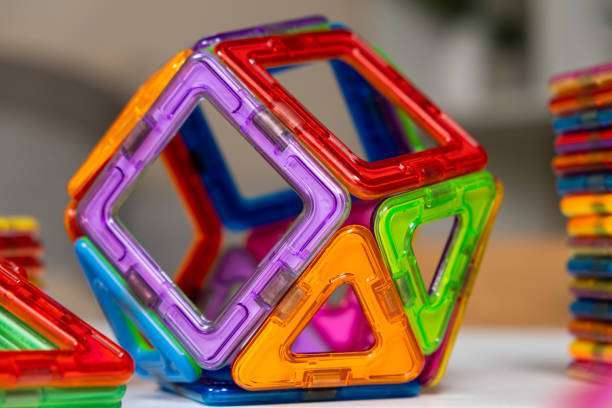
Light and color: the secret effects of visual stimulation
magnetic tiles is their “optical interaction.” The transparent sheets refract different colors under sunlight or lamplight, allowing children to observe phenomena such as “red plus yellow equals orange” and “blue plus green equals cyan” by stacking different colored sheets. This is not only an aesthetic experience but also a lesson in natural science.
Psychologists point out that this “dynamic light and shadow learning” can enhance children’s visual focus and color recognition. Unlike ordinary building blocks, the translucent properties of magnetic tiles keep children in a constantly changing light environment during the building process, providing continuous stimulation to the visual cortex. This type of visual input has a positive effect on the development of the cerebral cortex and provides sensory experience for understanding physical phenomena such as transparency, reflection, and color mixing.
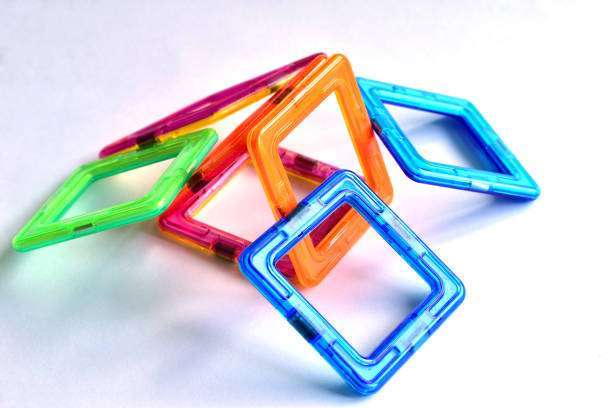
The Logic of Construction: From Free Assembly to Ordered Thinking
magnetic tiles lies in the fact that “there is no fixed answer.” Children can build houses, animals, vehicles, or castles in their wildest imaginations, and this freedom inspires creativity. But when they try to make the structure “stable” or “symmetrical,” they naturally begin to think about geometric logic problems such as balance, symmetry, and angles.
Educational researchers have found that children who are exposed to magnetic tiles for extended periods often demonstrate higher logical reasoning abilities when solving problems. This is because through countless failures and corrections, they develop a sense of cause and effect—why did the tower collapse? What angle would make it more stable? This acquisition of experimental thinking is the foundation of scientific literacy. Magnetic tiles, precisely through a game-like format, allow children to experience the scientific method of “hypothesis-verification-improvement” in a fun environment.
Social Interaction and Collaboration: Externalization of Spatial Cognition
Magnetic tiles lie not only in their impact on individual thinking but also in their social function. When multiple children work together to build them, they need to discuss the design, assign tasks, and coordinate the angles of the tiles. This process is equivalent to a mini “cooperative construction experiment,” which develops their language communication skills and teamwork awareness.
On a psychological level, collaborative building can also help children understand others’ perspectives, fostering empathy and a sense of spatial sharing. In other words, when children realize that others see structures differently from different angles, they are learning the advanced cognitive skill of “spatial transformation.” This ability forms the basis for drawing, engineering design, map reading, and even social interaction.
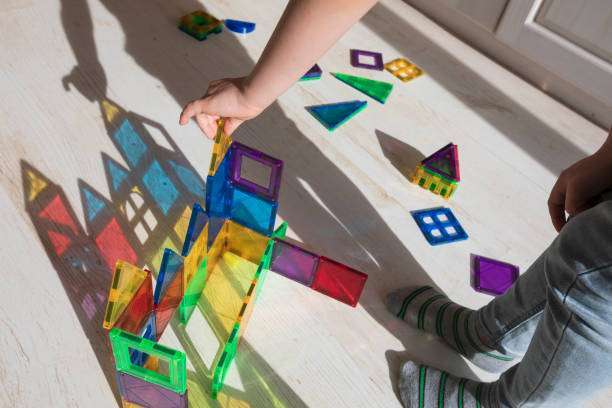
The role of parents: guiding rather than interfering
Many parents can’t help but intervene when their children are playing with magnetic tiles , hoping they will “build more beautifully” or “build higher.” But the truly effective educational approach is to let children lead the construction process. The parents’ role is to create an exploratory environment, providing inspiration and a sense of security, rather than controlling the outcome.
You can try using some open-ended questions to guide children’s thinking: “What would happen if we put this piece here?” or “What do you think sunlight would become when it shines through this color?” Such questions can activate children’s thinking and help them transform sensory observations into cognitive experiences.
magnetic tiles with their children under different lighting conditions , such as morning sunlight, evening glow, or flashlight illumination, helping them develop an understanding of the connection between light and shadow and space. This process of joint exploration is itself one of the most precious parts of family education.
From Games to Learning: Educational Implications of Magnetic Tiles
Magnetic tiles are no accident. It aligns with the modern educational philosophy of “learning through play,” presenting abstract spatial concepts in a visual and tangible form. Through the combination of light, color, and shape, it integrates scientific principles, aesthetic experiences, and psychological growth.
For children aged 3 to 8, these toys are not only for entertainment but also an important vehicle for early STEM education. They allow children to unconsciously engage with geometric thinking, physics, and visual arts, laying a solid foundation for their future creativity and logical reasoning. For parents, magnetic tiles offer a new educational perspective—playing with children is not a waste of time but rather a way of helping them build their cognitive structure of the world.
Conclusion
The “impact” of magnetic tiles lies not only in their colors and shapes but also in how they bring the educational process back to nature. In the moment of assembling, children are understanding physical laws; in the interplay of light and shadow, they are building logical thinking; and in the laughter of collaboration, they are learning the meaning of co-creation.
This is precisely the ideal state pursued by modern education—allowing knowledge to take root through play and science to sprout in childhood. Magnetic tiles, in their unique form, prove one thing: toys can also be the most powerful learning tools.