7 Common Mistakes in Magnetic Tile Construction: A Comprehensive Analysis of Stability and Magnetic Pole Errors

Among numerous children’s construction toys, magnetic tiles , with their transparent and bright appearance, strong magnetic attraction, and highly flexible play, have become a highly popular creative material throughout a child’s development. However, even the best materials need to be understood and used correctly, especially as children progress to more complex structures.
The underlying physical principles, mechanical distribution, and magnetic pole orientation differences of magnetic tiles can all affect the stability of the creation and its ability to maintain its shape over time. Many parents and teachers mistakenly believe that magnetic tiles can be “just be used randomly,” but in reality, incorrect building methods can not only lead to frequent collapses but also affect a child’s understanding of spatial relationships during construction, thus reducing their confidence in building.
Understanding the reasons behind common mistakes with magnetic tiles can not only help children build more stable, higher, and more complex structures but also allow them to develop judgment, spatial reasoning skills, and psychological resilience in the face of failure through repeated adjustments.
To truly master stable construction with magnetic tiles , it’s essential to understand the root causes of collapse. Most errors aren’t due to children being “not smart enough,” but rather because magnetic tiles , as a material with magnetic properties and structural mechanics, possess inherent “unspoken rules.” These rules don’t rely solely on gravity and friction like traditional building blocks; they require consideration of magnetic direction, connection angles, fulcrum positions, and the force relationships between surfaces.
When children haven’t grasped these principles, their creations are prone to instability. This article will discuss seven common mistakes, analyzing their causes and solutions to help parents, teachers, and companions better understand how to enhance children’s construction skills through play, making magnetic tiles a natural tool for learning physics, spatial awareness, and logical reasoning, rather than a source of frustration.
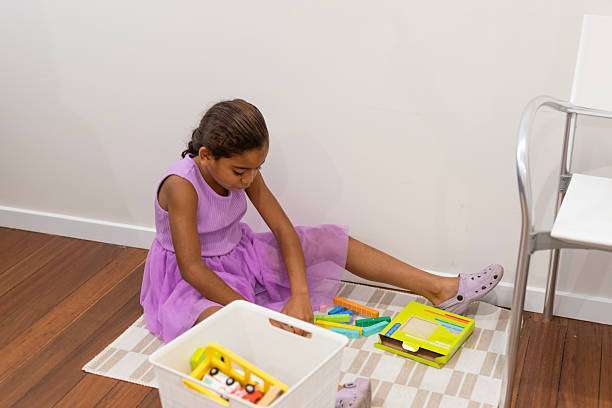
Part 1 : The Root Cause of the Tilting of Magnetic Tiles Artwork: A Chain Reaction Caused by Misjudging Stability
When magnetic tile creations collapse, many children assume it’s because the magnets weren’t strong enough or the material was broken. However, the real reason often stems from a misunderstanding of stability. For example, if a child doesn’t create a sufficiently wide and balanced support at the bottom but piles too much weight on top, the structure’s center of gravity shifts.
While magnetic tiles can attract each other, magnetism isn’t the same as “glue” that holds the structure together; it only maintains the connection between tiles, not counteracting lateral forces from above. Once the external force exceeds the magnetic tiles ‘ attraction, the structure easily breaks at its weakest point. If children repeatedly struggle with these failures without understanding the reasons, they may believe they “can’t build well.” Therefore, helping them understand the “underlying logic” of stability is crucial.
magnetic tiles begins with understanding the center of gravity. Children often enjoy building towers or spires because they are more visually satisfying, but these shapes inherently require a high center of gravity. If the base isn’t large enough, the tower will easily topple over, just like a one-legged table in the real world. Understanding this helps children move from “blindly stacking” to “planning structures.” This is the educational value of magnetic tiles —they are a medium for learning structural concepts through failure, rather than a static instruction toy.
Part Two: Incorrect Magnetic Pole Direction: How the Invisible Magnetic Force Affects the Success or Failure of a Work
Many people are unaware that the magnets inside magnetic tiles are directional, and different brands use different magnet arrangements. Some magnetic tiles have all their magnetic poles aligned, allowing them to easily attract each other from any direction; however, some magnetic tiles exhibit slight repulsion in certain directions. When children are building houses, bridges, or spheres, if the magnetic poles of two magnetic tiles are misaligned, they may slip slightly or not attract firmly. Children are often confused: “Why did they stick together, but then fall apart with a slight touch?” This is because magnetic pole alignment has a preferred direction; if the orientation is misaligned during construction, the magnetic strength decreases, leading to an unstable creation.
When parents are with their children, they can guide them to observe the “natural direction of magnetic tiles adhering.” Many magnetic tiles automatically adjust their angle when correctly aligned, creating a slight attraction to one side. This is part of the process of children learning about magnetic poles. Helping children understand that “not all edges have the same attraction” helps them observe the connection points more carefully when building, resulting in a more stable structure.
Part Three: Angle Splicing Errors: The Inspiration from the Principle That Triangles Are Much More Stable Than Squares
Many children enjoy using square and rectangular magnetic tiles to build towers, fences, or large planar structures, but they often overlook a key principle of mechanics: rectangular structures are more prone to deformation under external forces, while triangular structures possess inherent stability. When a child stacks a wall made entirely of square tiles, even a slight lateral force will cause the wall to sway and eventually collapse because the sides and corners of the squares cannot provide sufficient support. Conversely, a structure built with triangles, like a truss bridge in reality, can distribute external forces, allowing the structure to maintain a more stable shape.
This is extremely valuable for children’s understanding of mechanical principles. When they realize that triangles can “strengthen structures,” they will naturally try to mix triangular and square tiles to build, making the forces on their creations more balanced. For example, when building a tower, adding triangular braces can significantly improve stability. This learning process “from experience to understanding” is precisely why magnetic tiles can be such an inspiring material.
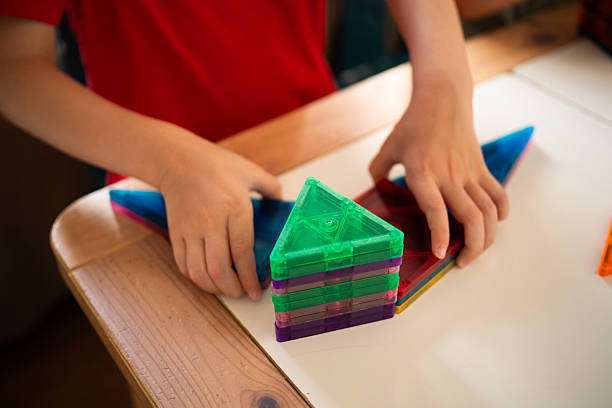
Part Four: Insufficient Base Area: The design, which narrows towards the top, leads to structural imbalance.
Children often like to imitate real-world architectural shapes, such as pointed castles, skyscrapers, or pyramids. However, many children don’t realize that a narrower top and a wider base are key to structural stability. If a child starts with a smaller base and then keeps stacking on top, the center of gravity will shift upwards. When the center of gravity deviates from the center of the base, the creation will inevitably tip over. This isn’t just a problem with magnetic tiles ; it’s a common principle followed by all building materials.
When guiding children in building structures, you can lead them to observe whether the base is large enough and encourage them to expand the base into a wider support structure, which will directly improve the stability of the finished product. Understanding the distribution of the center of gravity through practical actions is more effective than abstract explanations.
Part 5: Misjudgment of External Interference: Even slight vibrations can affect the structure of magnetic tiles.
Many children lack awareness of the fragility of magnetic tile structures. They often unintentionally touch the table or floor after building, causing the structure to vibrate and collapse. Although magnetic tiles have strong magnetic attraction, they are still insufficient to resist sudden lateral sliding. Some children may mistakenly believe that “the building collapsed by itself,” and if parents do not explain this, it can lead to frustration. Understanding the influence of external forces on stability can also help children learn to stay focused, control their movements, and improve their physical coordination during the building process.
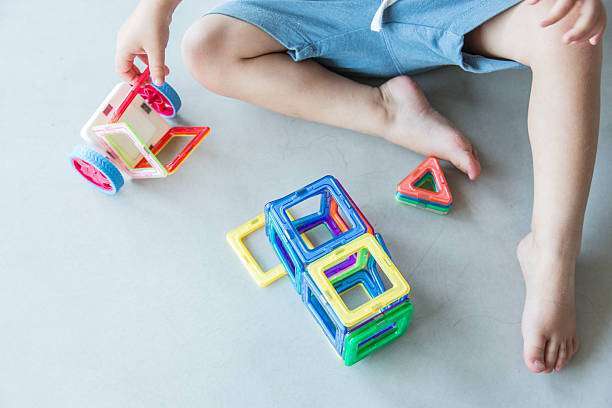
Part Six: High-Altitude Assembly Errors: The higher up you go, the easier it is for the structure to loosen due to unstable hands.
As children build taller structures, they often need to reach out, step, or even stand on tiptoe to join the pieces. These movements can easily cause them to lose stability, leading to slight misalignments in already assembled sections. In magnetic tiles , which rely on adhesion to maintain their structure, even the slightest misalignment can result in uneven stress at the joints, ultimately causing a sudden collapse within minutes. This delayed collapse is more likely to confuse and frustrate children. Helping children understand that assembling at heights requires gentler movements and learning the method of “supporting before assembling” can help them succeed in building tall structures.
Part 7: Uneven magnetic attraction due to mixed materials: Differences in magnetic attraction between different brands of magnetic tiles
magnetic tiles from different brands , but parents may not realize that magnetic strength and the arrangement of the magnets differ. When using them interchangeably, some brands may have weaker magnetic strength, creating weak points in the structure. When children build large models, these weak points may collapse under the overall pressure. The correct approach is to help children understand the differences between materials and to use the same brand as much as possible in large structures, or to place weaker magnetic tiles in areas with lower stress. Through this practice, children learn to compare, judge, and select materials, not just how to assemble them.
Conclusion
Magnetic tiles may seem simple, but each successful and unsuccessful attempt at building them conceals complex laws of mechanics, magnetic knowledge, and structural logic. Through these experiences, children are not merely completing a project, but understanding how the world works. Every collapse is not a failure, but a stepping stone to a more solid foundation for future learning. The role of a companion is not to prevent mistakes, but to help children find patterns in their errors, giving them the courage to try again. By mastering seven common building mistakes, children can not only build taller, more stable, and more beautiful magnetic tiles , but also gain patience, reasoning skills, and resilience in the face of challenges.