Magnetic tiles offer 3 sustainable educational benefits: teaching children about environmental protection through reuse.

In modern family and educational environments, sustainable education has gradually become an important and unavoidable theme. When children’s lives are surrounded by disposable toys, rapidly evolving electronic products, and overly packaged children’s products, parents and teachers are beginning to consider: what materials can accompany children’s growth while naturally helping them understand the importance of environmental protection, resource conservation, and sustainable use? Magnetic tiles have emerged as an educational tool in this context. As a reusable, long-lasting building material with an open-ended play style, it not only stimulates children’s creativity but also subtly cultivates their environmental awareness. The value of magnetic tiles extends beyond playability; it serves as a medium for children to understand sustainable concepts through play.
magnetic tiles naturally endows them with durability and recyclability. Unlike many craft toys that require consumable materials, magnetic tiles produce no waste during use. Children don’t need to tear, glue, or cut during the creation process, thus avoiding additional litter. In many educational systems that emphasize environmental education, reuse, waste reduction, and extending the lifespan of products are key concepts, and magnetic tiles are precisely the right material to integrate these ideas into everyday play. This article will analyze how magnetic tiles help children understand environmental concepts through reuse and develop a positive environmental attitude as they grow, starting from the three core values of sustainable education.
Part One: Establishing the Concept of Sustainable Materials: From Reuse to Understanding Limited Resources
For toddlers and children, environmental protection concepts are often abstract and distant. When they hear about “saving resources” and “reducing waste,” they usually struggle to find concrete examples in their daily lives. However, the reusable nature of magnetic tiles provides children with a direct experience with the material. Every time a child builds, dismantles, and rebuilds, it’s a process of perceiving the life cycle of materials. They discover that magnetic tiles don’t break when disassembled, and there’s no need to spend extra resources to replace parts. When children can repeatedly use the same set of materials to complete different projects, they naturally realize the durability and value of materials.
This experience is crucial for their understanding of the concept of resources. Many children in modern society are accustomed to a “use and discard” consumption pattern; the toys they encounter are often disposable, easily damaged, or quickly phased out due to limited functionality. However, the strength and durability of magnetic tiles allow children to clearly experience the process of “a toy lasting a long time.” This emotional connection not only increases their appreciation for objects but also helps them understand, through long-term use, that resources are not infinitely available. By incorporating magnetic tiles into daily play, children gradually develop a subconscious sense of responsibility towards materials, moving away from constantly replacing items and instead seeking new possibilities from existing resources.
From an educational perspective, the reusability of magnetic tiles also provides teachers with opportunities to guide children in discussing environmental issues. Children often ask questions while building, such as why magnetic tiles don’t break, why they can be played with indefinitely, and why they don’t need to be thrown away. These questions serve as entry points for sustainable education. Teachers can use these questions to further guide children to think about issues such as the lifespan of items, manufacturing processes, and resource consumption, allowing children to gradually develop a concept of sustainable materials through independent exploration.
Part Two: Sustainable Experiences from Multi-Purpose and Long Lifespan: A Toy Accompanying Multiple Stages of Growth
magnetic tiles lies in their high adaptability and long lifespan. Many toys have a very short lifespan, often only suitable for a certain age group. As children’s abilities improve or their interests shift, the toys lose their value and are eventually shelved or discarded. But magnetic tiles are different. They can accompany children from early childhood to higher grades, and the complexity of their play expands as children’s abilities develop.
For three-year-olds, magnetic tiles are primarily used to introduce colors and shapes and for simple building. They may only construct flat shapes such as windows, bridges, or simple puzzles. At this stage, magnetic tiles are more of a sensory material, allowing children to experience the fun of adsorption, connection, and combination.
Between the ages of five and eight, children begin to develop an awareness of three-dimensional structures, enabling them to build more complex works such as cubes, pyramids, castles, and houses. Magnetic tiles become a tool for spatial construction and basic scientific exploration at this stage, and children gradually understand structural stability, center of gravity, symmetry, and the logic of form.
As children grow older, their creativity expands to more diverse areas, such as building spherical structures, bridge models, experimenting with geometric angles, and even studying light and shadow. The transparent material of magnetic tiles allows children to explore light refraction and color layering, transforming magnetic tiles from simple toys into an interdisciplinary learning medium.
This growth path reveals the sustainable value of magnetic tiles : they don’t need to be replaced as children grow, but are inherently adaptable to different skill levels. Extending the toy’s lifespan not only reduces resource consumption for families and schools but also allows children to experience the concept that “a material can have many uses.” This versatility is an important component of sustainable education, helping children understand that the value of an object is not limited to a single function but can demonstrate multiple possibilities in different contexts.
Families and educational institutions often need to consider cost and space when choosing toys, but the high adaptability of magnetic tiles makes them a highly valuable investment. They not only reduce the need to buy toys for other stages but also decrease the likelihood of toys being discarded. By frequently using the same material, children can develop a genuine awareness of “long-term use,” rather than relying on constantly updated consumption patterns. This understanding and appreciation of durable goods is a crucial starting point for sustainable education.
Part Three: A Learning Model of Circular Construction: Understanding Environmental Thinking Through Continuous Deconstruction and Reconstruction
magnetic tiles emphasizes disassembly and reconstruction. This cyclical construction model not only enhances creativity but also serves as a natural and environmentally friendly learning method. Children repeatedly experience completing, disassembling, redesigning, and rebuilding their creations. This cycle helps them understand an important concept: materials are not waste after use but rather a new starting point for creation. Compared to many toys that require raw materials to create new works, the play style of magnetic tiles aligns more closely with the recycling and reuse principles emphasized in sustainable education.
Cyclical constructivist learning helps children develop a basic understanding of “resource recycling.” When children learn to disassemble and reuse magnetic tiles , they are also cultivating a mindset that doesn’t view materials as disposable items. Children gradually understand that materials don’t lose their value after use, but can always play a role in new creations. This experience is especially valuable in environmental education because it transforms environmental protection from a concept into a tangible and experiential behavior.
The process of cyclical construction also cultivates children’s flexibility and problem-solving abilities. Through repeated redesigns, children learn that solving problems doesn’t require new materials, but rather finding better solutions through reorganization, structural adjustments, and recombination. This idea of “solving problems with existing resources” is at the core of sustainable education and a crucial skill that children will need throughout their lives.
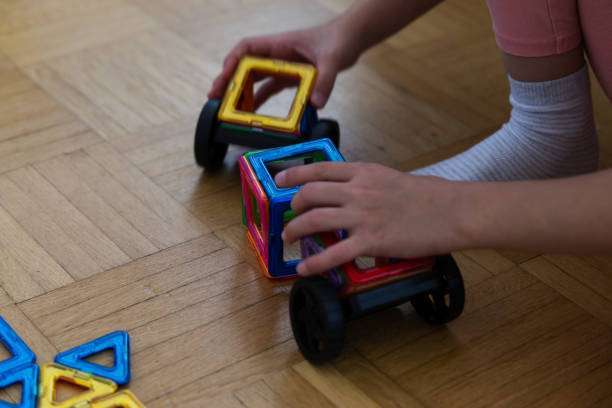
In a home environment, parents can further reinforce this cyclical thinking through shared play experiences. For example, when a child completes a castle but stops playing, parents can encourage them to disassemble the creation and build new structures using the same materials. Through this process, children experience that “the end of something doesn’t mean waste, but rather an opportunity for a new beginning.” This understanding will manifest in deeper ways in their future lives, such as reducing impulsive spending, reusing items, and conserving resources.
In schools and kindergartens, teachers can integrate the circular construction of magnetic tiles into environmental education curricula through project-based learning. For example, magnetic tiles can be used to simulate resource recycling processes, a set of magnetic tiles can be used to complete multiple thematic tasks, or children can complete designated challenges with limited materials, thus helping them understand the finiteness of resources and the importance of material reuse. Through these practical activities, the circular construction model becomes an effective sustainable education method, enabling children to naturally develop environmental awareness through play.
Conclusion
Magnetic tiles are not only creative building toys, but also educational materials that help children understand sustainability through play. Their reusability allows children to appreciate the durability and preciousness of resources; their long lifespan helps them understand the extended value of objects at different stages of development; and their circular construction pattern allows children to learn environmental thinking through continuous disassembly and reconstruction. Sustainable education should not be an abstract concept, but should be integrated into children’s daily lives through concrete materials and practical actions. Magnetic tiles are precisely such a material, accompanying children in building their world while deeply embedding environmental awareness into their growth experience.