Magnetic Tiles: 4 Age Groups’ Understanding Differences: From Intuitive Play to Design Creation

Over the past decade, magnetic tiles have become one of the most popular open-ended toys in homes and educational settings, serving as a foundational material for many children’s construction, light and shadow exploration, and creative learning. While magnetic tiles may seem simple—just colorful, transparent sheets that adhere to objects—children of different ages exhibit entirely different characteristics in their manipulation methods, perspectives, thinking patterns, and creative depth.
From the intuitive exploration of early childhood to the rule-making of preschoolers, and then to the structural logic and design creativity of elementary school students, each age group redefines the meaning of magnetic tiles in different ways . Magnetic tiles not only embody the joy of construction but also reflect the trajectory of children’s cognitive development, making them a material that accompanies children as they grow.
This article will delve into the differences in children’s understanding of magnetic tiles from four key age stages, exploring how they gradually grow from passive sensory experiencers into budding builders with design thinking. By analyzing how children observe, understand, make mistakes, adjust, and innovate, we can better understand why magnetic tiles can transcend age limitations and become an educational material suitable for preschoolers and school-aged children.
I. The Intuitive Exploration Stage Around Age Three: Touch, Adhesion, and the Most Primitive Constructive Impulse
Around the age of three, children’s understanding of the world relies on their senses. They haven’t yet developed systematic construction goals, nor do they plan what they want to build. Their interest in magnetic tiles focuses on the tactile sensation, the magnetic sound, the color transparency, and the most basic physical feedback.
At this stage, children’s understanding of magnetic tiles largely comes from the “instant reaction to the material.” When they bring one magnetic tile close to another, the moment the magnetism causes it to attract, it triggers their most direct sense of surprise. This surprise drives them to repeatedly perform the behavior of attracting, separating, and attracting again.
At this age, children aren’t focused on structural stability or tall, imposing shapes; they’re more concerned with the manipulability of the material itself. They’ll constantly test the angles, strength, and directions of adhesion, such as sticking the magnetic tiles to the edge of a table from different positions or trying to make them “jump” onto another tile. They don’t care whether the result is a recognizable structure, but rather whether the action brings new sensory experiences.
The transparent visual effect of magnetic tiles is extremely attractive to children of this age; they’ll hold the tiles up to the light to see how the colors change the light and shadow on the back of their hands or the wall, and they’ll also repeatedly overlap different colors to observe the changes after color layering.
At this stage, the significance of magnetic tiles lies in their ability to respond to movement. Children learn about the material’s stability, edge shape, magnetic direction, and the effect of light transmission through continuous experimentation. Their play is highly random, but this randomness forms a crucial foundation for developing intuitive cognition. The greatest value of magnetic tiles at this stage is providing a material that requires no skill or rules yet offers continuous feedback, enabling children to build initial spatial awareness, muscle control, and hand-eye coordination through free exploration.
II. The Emergence of Structural Awareness in Four- to Five-Year-Olds: From Stacking to Frameworks, From Imitation to Construction
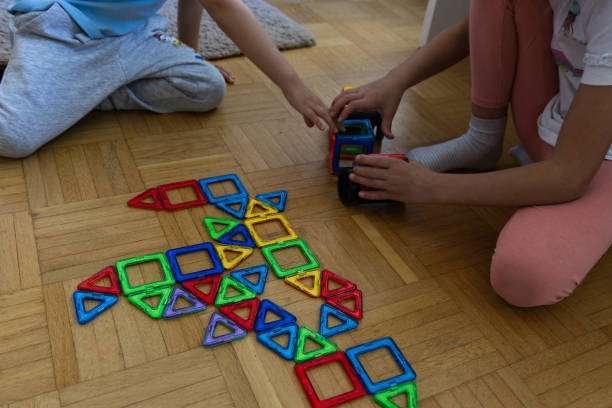
When children reach four or five years old, their cognition begins to shift from purely sensory perception to rudimentary structural reasoning. They will attempt to build “things they can understand” for the first time. Children at this age begin to focus on the outcome and will want magnetic tiles to become houses, cars, castles, animals, or objects familiar to them in their daily lives. This indicates that children have moved from random exploration to the symbolic construction stage. They will strive to make their creations represent specific images and be able to describe what they are building.
At this stage, children begin to learn about structural stability. They realize that certain combinations can cause a building to collapse, while certain angles are more stable. They learn through repeated failures, such as why triangles are more stable at the top, why squares need supports, and why connection points must be left between two structures. At this time, the geometric differences in magnetic tiles begin to provide them with cognitive support; children observe that triangles can form more stable roofs, squares are suitable for building walls, and long strips can increase height or extend space.
Their approach also shifted from vertical stacking to enclosing spaces. They no longer built just “a tower,” but rather “complete houses” with walls, doorways, and roofs. They began to understand spatial concepts, such as the difference between inner and outer spaces, the need for passageways between structures, and how bilateral symmetry makes architecture more aesthetically pleasing. This stage also saw their first instances of “imitation-based construction,” such as seeing a window in their home and attempting to recreate a similar structure using square magnetic tiles, or trying to transfer the shape of a block roof onto magnetic tiles .
Playing with light and shadow becomes apparent at this stage. Children will discover how light changes as it passes through structures, such as how light can pass through windows, how shadows change with height, and how different colors cast different patches of light on the ground. They will repeatedly disassemble and rebuild to observe light and shadow, and will be attracted by the changes in color within the light. Light and shadow are no longer just sensory stimulation, but begin to become an “additional goal” in construction. Some children will even adjust the structural layout to create more concentrated light in a particular corner.
Overall, four- to five-year-old children have already developed basic construction logic, and their thinking has expanded from “sensory results” to “structural purpose.” This is an important reason why magnetic tiles are widely used in curriculum teaching at this age.
III. Rule Understanding and Design Embryonic Stage (Ages 6-7): The Leap from Simple Models to Structural Planning
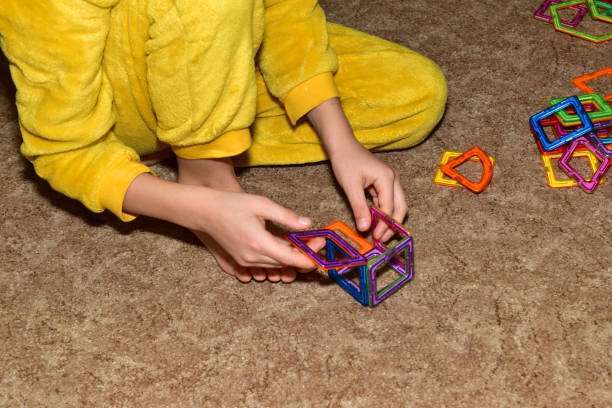
When children reach six or seven years old, their construction methods enter their first significant leap. They are no longer satisfied with single-story houses or simple models, but instead attempt larger-scale constructions, such as multi-story buildings, bridges, observation towers, and complete city layouts. At this stage, they begin to develop planning abilities, considering what structures are needed, how to connect them, and how to ensure the final product is completed before starting construction. This planning ability marks the beginning of their design thinking.
They also begin to understand the load-bearing relationships of structures for the first time. For example, a tall tower needs a wider base, a bridge needs symmetrical supports, and both ends must remain balanced. The magnetic connection properties of magnetic tiles make it easier for children to observe the reasons for failure. When a structure collapses, they can determine whether it’s due to an angle problem, insufficient magnetism, or a misaligned support point. This prompts them to continuously adjust their strategies, making the construction process a logical reasoning process.
In terms of light and shadow, children are beginning to use light more actively. They plan structures based on the direction of the light, casting different colors onto the wall to create gradient light and shadow. Some children even start creating light and shadow patterns, such as piecing together stars, rainbows, windowpanes, and three-dimensional shadow shapes. They also try rotating or moving the structures, observing the dynamic changes in geometric shapes through the changes in shadows. This is no longer just visual observation, but the earliest form of optical experimentation.
At this stage, children also use magnetic tiles as “modeling materials.” They imitate real-world buildings, such as schools, shops, towers, and bridges, using magnetic tiles to create urban designs. They collaborate with peers, assembling different modules into large structures, learning communication and task allocation in the process.
Children in this age group begin to show “design prototypes.” They can envision the outline of a structure in advance and proactively modify their designs after failures. Their constructions begin to exhibit core characteristics of engineering thinking, such as structural optimization, model adjustment, functional zoning, and stability improvement. Magnetic tiles are no longer just toys in their hands, but become tools for expressing ideas.
IV. Creative Design Stage (Ages 8 and Up): The Mature Stage from Structural Replication to Original Design
By the time children reach the age of eight or older, they demonstrate a clear purpose and high level of creativity when working with magnetic tiles . They can construct complex three-dimensional structures, such as spherical domes, long-span bridges, spiral towers, and giant light and shadow installations. They begin to focus on proportion, rhythm, aesthetics, and functionality, rather than just structural stability. They are no longer content with simply replicating buildings in their lives but will create new architectural forms, such as futuristic cities, science fiction buildings, mechanical structures, or fantasy scenes.
Before construction, they conduct “pre-design,” such as planning the theme first, and then determining the color combination, structural layering, and the placement of light and shadow. They possess abstract thinking and spatial reasoning abilities, enabling them to predict the final form of the structure in their minds, and to independently solve problems such as connection difficulties or structural instability.
At this stage, light and shadow become an important part of the design language. Children will actively use the transparency, color differences, and light refraction of magnetic tiles to create artistic works of light and shadow. For example, they will build multi-layered structures to create depth effects on the wall; they will use the superposition of specific colors to create gradient patterns; and they will even design “viewing angles” for the light and shadow structures to ensure that the shadow presents the most beautiful shape when viewed from a specific direction.
In children aged eight and above, their understanding of magnetic tiles enters the “design and creation phase,” which is the peak of the educational value of magnetic tiles . Children’s play is no longer experimental and random, but rather possesses a clear artistic, engineering, and logical element. They use magnetic tiles to build their own creative world, and the openness of magnetic tiles provides them with ample space for expression.
Conclusion
From intuitive experiences before age three, to the budding of structure at four or five, to the understanding of rules at six or seven, and finally to design and creation at eight and above, magnetic tiles witness the entire process of a child’s growth from a sensory explorer to a creative thinker. Each age stage involves a completely different way of understanding magnetic tiles , and each advancement in understanding signifies an expansion of cognitive abilities.
Magnetic tiles are not just a material, but also a language. For young children, they are a window to the world, a first encounter between magnetism and light; for older children, they are a practice field for constructing logic, a first opportunity to understand “structure”; for school-aged children, they are a bridge for engineering models, light and shadow experiments, and spatial exploration; and for children over eight years old, they have become a tool for design and creation, a medium for them to express their imagination.
Magnetic tiles transcend age because they offer children the openness to explore, evolve, fail, and try again. They don’t provide a single answer, but rather allow children of every age to understand, construct, and create at their own pace. Different ages using them isn’t a difference, but rather a reflection of their developmental trajectory. A set of magnetic tiles is never just a toy, but a cognitive journey spanning the entirety of childhood.