The 10-Year Design Evolution of Magnetic Tiles : A Stunning Transformation from Building Blocks to a Medium of Light and Shadow

In the rapid development of contemporary children’s toys, few materials have evolved like magnetic tiles , transforming from simple building blocks into a creative medium that integrates constructive thinking, artistic expression, sensory exploration, and even light and shadow experiments.
Over the past decade, it has transformed from a substitute for disassembling building blocks into an open-ended tool embraced by parents, educators, and designers alike. The evolution of magnetic tiles is not merely a change in shape, but a profound integration of children’s cognition, materials science, optical representation, and aesthetic needs—a history of evolution that combines educational value with design aesthetics.
This article traces the evolution of magnetic tiles over the past decade, showing how they transformed from simple magnetic building blocks into a medium that refracts light, evokes emotions, and constructs spaces. It not only documents the progress of the toy industry but also reflects the changing trends in children’s education over the past ten years.
As the narrative unfolds, you will see how magnetic tiles have transcended geometric structures, material technology, and visual language, transforming what began as a simple building game into a more futuristic experience of light and shadow.
The first phase : the revolutionary starting point from geometric building blocks to magnetic connections.
Ten years ago, magnetic tiles primarily emerged as an extension of building blocks. Traditional building blocks relied on stacking to maintain their structure, while magnetic tiles allowed children to freely combine tiles by “connecting edges,” freeing construction from the constraints of gravity or friction.
Early magnetic tiles mostly used basic geometric frameworks, with squares, triangles, and trapezoids forming the most traditional structural system. Although the colors were relatively basic and the transparency less than later versions, the intuitive experience of “attaching and fixing” allowed young children to understand the construction logic in a very short time.
At this stage, magnetic tiles primarily address two pain points. First, there’s the issue of block structures easily collapsing. Magnetic tiles, with their magnetic stability, allow children to quickly restore the structure after incorrect attempts, reducing frustration. Second, they increase building speed.
Children can continuously attach tiles, eliminating the need for layer-by-layer stabilization like with blocks, significantly accelerating the transformation of ideas into structures. This positive psychological effect on children is key to the rapid popularity of early magnetic tiles ; they allow children to see results quickly and make it easier for parents to participate in the construction process.
At this stage, magnetic tiles did not yet emphasize light and shadow effects, but the transparent material and color combinations laid the foundation for future explorations of light and shadow. The somewhat simple but functional design of the first-generation products reserved space for more complex visual languages in the future, and also gave magnetic tiles the potential to become an innovative medium from the very beginning.
Phase Two: Material Upgrades and Structural Optimization: System Reconstruction Focusing on Durability and Safety
As magnetic tiles become more widespread in education, their design focus has shifted from “playability” to “long-term durability.” In the second phase, brands began optimizing from a materials science perspective. For example, higher-transparency ABS materials became mainstream, edge-wrapping magnetic strips technology matured, and the welding method for magnetic sheets evolved from spot welding to ultrasonic edge sealing, resulting in higher overall product strength and better safety.
In terms of structure, the brand began to enhance the shape diversity of magnetic tiles while maintaining interlocking compatibility. This stage saw the emergence of more complex geometries, such as arched tiles, fan-shaped tiles, and long rectangles, supporting more intricate architectural structures.
For example, roof slopes could be presented more naturally, vehicle fronts could be shaped more smoothly, and tower proportions were closer to real buildings. With the expansion of shape variety, children were able to simulate more realistic spatial layouts using magnetic tiles and began to understand the role of different structures within the overall structure.
On a visual level, the significantly improved transparency allowed light to pass through the magnetic sheet more cleanly, and color saturation became more uniform. This upgrade not only enhanced aesthetics but also laid a solid foundation for light and shadow experiments. Children gradually became able to observe the changes in light passing through the magnetic sheet and experience the visual effects produced by overlapping different colors. Although the brand at the time still primarily emphasized construction skills, the improved materials allowed light and shadow experiences to begin to appear as a “byproduct,” gradually attracting the attention of educators.
The key to this stage lies in the increased safety, which has driven the expansion of usage scenarios. Magnetic tiles are no longer limited to the home and are widely used in kindergartens, sensory integration classrooms, and children’s activity spaces because their drop-resistant, pressure-resistant, and bite-resistant properties make them more reliable.
With the inclusion of educational scenarios, magnetic tiles are no longer just toys but are gradually transitioning into educational tools, preparing for future creative functional upgrades.

The third stage: the emergence of color evolution and the manipulation of light and shadow: from visual stimulation to the expansion of optical cognition.
As material technology and structural foundations gradually stabilized, the brand began to make breakthroughs in its color system. In the third phase, magnetic tiles achieved a more refined color language. The original basic colors were subdivided into gradient colors, crystal colors, gemstone colors, and smoky colors.
The changes were mainly reflected in two directions: firstly, the variety of colors increased, making visual combinations richer; secondly, the control of light transmittance became more precise, allowing light to present different brightness and hues when passing through different magnetic sheets.
During this period, the interplay of light and shadow began to become an explicit design goal. Designers began to realize that magnetic tiles not only served a spatial construction function, but could also be an ideal medium for experimenting with light.
For example, children could experience the mixing of light by layering different colors, and observe the changes in the angle of shadows created by light projecting into the structure. Many brands began to produce magnetic tiles specifically for light and shadow walls, enhancing transparency and reducing light obstruction at the edges to make the light and shadow effects clearer.
Visual evolution has transformed magnetic tiles from static structural tools into tools for visual exploration. Children not only build towers, cars, and houses, but also place the tiles in sunlight or in front of flashlights to observe how light passes through shapes.
Phenomena such as light refraction, projection ratios, and color overlap—phenomena that were previously difficult to represent with simple building blocks—become simple and concrete through magnetic tiles. The light and shadow properties of magnetic tiles have thus been formally awakened, and they have begun to possess both artistic and scientific educational functions.
During this stage, parental feedback changes significantly. They no longer focus solely on the structural stability but begin to appreciate how colors stimulate children’s attention and sustained focus. For example, children may be more willing to repeatedly build structures due to changes in light and shadow, and may develop new creative inspiration from color combinations. This shift from structural to visual elements marks the transition of magnetic tiles from functional toys to experiential toys.
The fourth stage of education fully integrates educational philosophies: from construction tools to interdisciplinary enlightenment media.
With the global popularization of STEAM education, the design focus of magnetic tiles has expanded further. Designers have begun to view magnetic tiles as a bridge for interdisciplinary learning, rather than just a simple building material. The fourth stage of products incorporates more structural designs that support mathematics, engineering, aesthetics, and creative expression.
The complexity of structures has increased significantly, for example, with curved tiles for teaching spatial concepts, three-dimensional frame tiles for geometric exploration, and shaft structure tiles for connecting moving components.
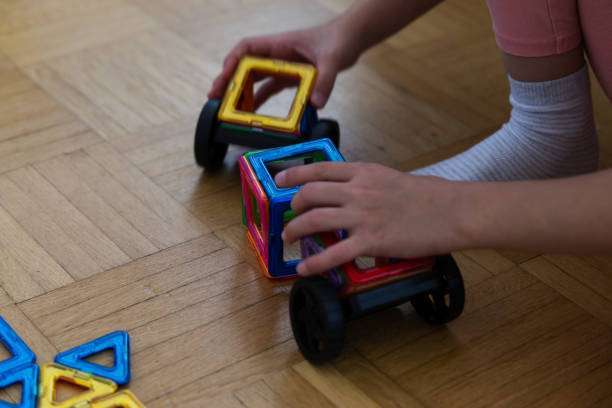
Children can use magnetic tiles to build wheels, rotating shafts, suspended platforms, and other structures, giving magnetic tiles the potential for mechanical movement for the first time. Construction is no longer limited to static elements but enters the exploration of dynamic systems.
Meanwhile, color systems have begun to serve education. For example, gradient color series help children understand the relationship between light and dark colors, transparent frame sheets help observe internal structures, and magnetic sheets with different levels of translucency make the differences in light and shadow more obvious. These visual details make magnetic sheets an adjustable visual research tool, allowing children to see the patterns inside structures while playing.
In curriculum design, magnetic tiles are beginning to be incorporated into sensory integration training, math activities, architectural introductions, logical reasoning, and even art creation courses. Educators have found that magnetic tiles simultaneously meet three key requirements: they can be freely combined, continuously adjusted, and repeatedly tested. This makes them ideal for developing design thinking, engineering thinking, and problem-solving skills.
During this period, magnetic tiles began to appear in more professional settings, such as children’s space design exhibitions, art installations, and early childhood architecture courses. They were no longer seen as toys only for children, but as a material with aesthetic and structural expressive capabilities. The key turning point of this stage was the recognition from the education sector, which elevated them from civilian toys to a semi-educational media tool.
The Birth of the Fifth Stage of Light and Shadow Media: From Color Construction to Cross-Border Integration of Visual Arts
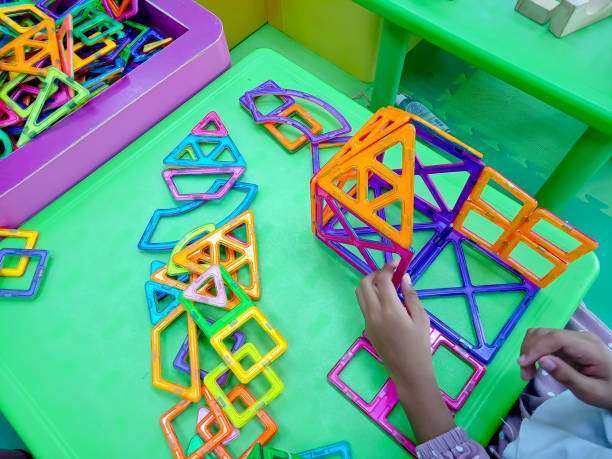
The most groundbreaking transformation of the past decade occurred in the fifth phase, when magnetic tiles officially transitioned from building block prototypes to a medium of light and shadow. Designers no longer focused solely on structural form but actively explored how magnetic tiles behaved with the help of light, such as light penetration, color layering, shadow variations, and the projected forms of three-dimensional structures. Product design in this phase not only pursued increased transparency but also incorporated light control technology into the materials, allowing light to present a purer sense of flow when passing through the magnetic tiles.
The first breakthrough is the systematic development of interactive light and shadow play. Brands began producing matching light and shadow bases, light and shadow projectors, and light and shadow walls to encourage children to explore the effects of light in dark environments.
When children place structures in front of a light source, the shadows will change shape depending on the angle. For example, the shadow of a cube will become a rectangle, and the shadow of a triangle will change its side length ratio due to tilting. These phenomena allow children to directly understand the relationship between spatial dimensions, angular changes, and the direction of light. The structure of magnetic tiles is thus given new life, no longer just a three-dimensional object, but a multi-form in light and shadow.
The second breakthrough is the fusion of color and optical effects. With increased transparency, different colored magnetic tiles can create more pronounced gradient effects under light. Overlapping two colors can produce a third, allowing children to unconsciously experiment with color mixing. Designers are also beginning to pre-plan visual rhythms in color layouts, such as using thin borders to enhance light penetration, resulting in more refined boundaries in light and shadow artworks; or using irregular shapes to create abstract light and shadow patterns in the shadows.
The third breakthrough lies in the expanded possibilities of artistic expression. Magnetic tiles are widely used in art-themed courses, visual creation workshops, and creative photography. Children can build giant structures and project light to create dreamlike images; they can also create multi-layered structures to create depth in shadows. This cross-disciplinary transformation from three-dimensional to two-dimensional and then to light and shadow images makes magnetic tiles a material with true artistic potential. Many child artists and educators define them as “children’s versions of light and shadow architectural models,” and they are even used in conceptual art exhibitions.
At this stage, magnetic tiles are no longer just children’s toys, but have become an art medium that can be used by both families and schools. Some brands have even launched special light and shadow series, extending the use of magnetic tiles to indoor light and shadow installations, making them part of home décor.
The true future direction of the sixth stage: the integration of intelligent lighting, structural logic, and material art.
After a decade of development, the magnetic tile industry is entering a new phase in three directions. The first is intelligent light and shadow integration. For example, magnetic tiles with built-in optical units, adjustable brightness structural bases, and magnetic tiles with special refractive textures allow light and shadow effects to no longer rely on external light sources, but rather achieve more possibilities within the structure itself. Children can create architectural models with their own light, producing dynamic or gradual light and shadow images.
Secondly, there’s the algorithmic approach to structural logic. Currently, some design teams are researching how to use magnetic tiles to represent more complex mathematical structures, such as fractal topology, modular building principles, and repeatable foldable structures. In the future, magnetic tiles may become “touchable models” for children learning spatial mathematics, allowing them to understand algorithmic logic through construction.
Thirdly, there’s the trend towards the artistic use of materials. As parents place increasing emphasis on aesthetic education, designers are beginning to incorporate artistic language into magnetic tiles , such as textured designs, light and shadow patterns, glass-like textures, and gradient films. This is gradually giving magnetic tiles a “decorative” quality, expanding them from toys into works of art that can be integrated into home spaces. In the future, magnetic tiles may become a composite medium that blends technology, art, and children’s education.
Conclusion
Looking back at its evolution over the past decade, we can see that the development of magnetic tiles is no accident. Its transformation from simple building blocks to a medium of light and shadow is due to its unwavering commitment to three core values: free construction, visual exploration, and interdisciplinary integration. From material upgrades to structural expansion, from color breakthroughs to light and shadow representation, from educational applications to artistic fusion, magnetic tiles have achieved the greatest leap a toy could make in a decade.
Today’s magnetic tiles not only embody children’s architectural fantasies but also allow them to observe the world through light and shadow; they not only help them understand shapes and structures but also express emotions and aesthetics; they not only function in bright daytime spaces but also create art in the light and shadow environment of the night. It has become a language between science and art, allowing children to think while constructing, imagine in light and shadow, and grow through trial and error.
This decade-long evolution of design also symbolizes the upgrading of children’s education philosophy. Magnetic tiles, with their open, transparent, and manipulable characteristics, will continue to be an important medium for children to explore the world, express themselves, and create possibilities in the future. Today, we can clearly say that magnetic tiles are no longer just magnetic building blocks; they have become a new language of light and shadow, an architectural art material for children, and a core tool that is leading the way in future creative learning.