7 Turning Points from Play to Learning with Magnetic Tiles : Powerful Methods for Naturally Initiating STEM Education

Why is it that some children simply play with magnetic tiles , while others actually learn from them?
Many parents have a vague sense of unease. They’ve bought magnetic tiles , and their children are indeed building with them every day. The colors are beautiful, and the shapes are getting more and more complex, but it always feels like this kind of “play” is missing a step from real learning. You’ve heard that magnetic tiles can be used for STEM education, cultivating spatial thinking, engineering awareness, and scientific understanding, but in reality, what you see is children repeatedly building and dismantling houses, without any clear “progression.”
The problem isn’t with magnetic tiles themselves, but with whether they’ve truly bridged the key transition points from “sensory toys” to “cognitive tools.” STEM education isn’t achieved through lecturing; it’s about children gradually realizing rules, structures, and cause-and-effect relationships through repeated experimentation. Magnetic tiles are an excellent medium for this, but only if these seven transition points are triggered naturally, not through forced instruction.
The first turning point: a shift from color-based attraction to structural attention.
Almost all children are initially drawn to magnetic tiles by their colors. The interplay of red, blue, and yellow under light instinctively stimulates their visual system. At this stage, children’s attention is primarily focused on what makes them “pretty,” “bright,” and “color-changing,” which is a perfectly normal starting point.
The real turning point comes at a certain moment when children stop focusing solely on the color of individual pieces and begin to notice “what happens when they are put together.” They discover that the same color produces completely different effects when pieced vertically versus horizontally; two pieces stacked together create a darker color; and when enclosed in a space, the light inside becomes softer. At this moment, their attention shifts from sensory stimulation to structural relationships, and STEM education truly begins to sprout.
This turning point doesn’t require any explanation. You just need to provide a stable light source and enough space for the child to observe the changes repeatedly. When the child starts to stop and stare at the inside of the structure instead of just looking at the individual pieces in their hands, you’ve quietly crossed the first threshold.magnetic tiles.
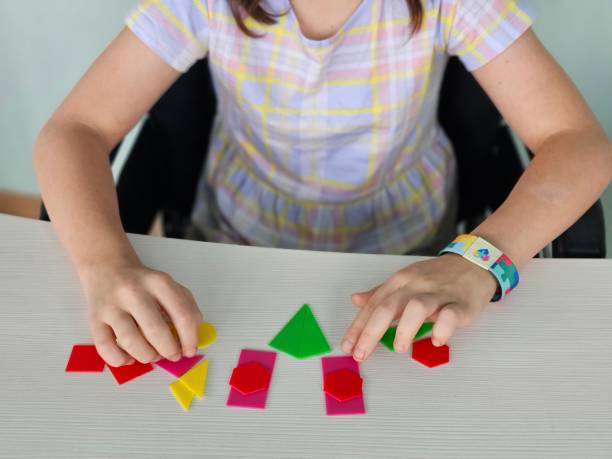
The second turning point: from random piecing together to the awakening of the consciousness of “being able to stand firm”.
In the pure play stage, children are not sensitive to “collapse.” Falling down and rebuilding is itself a kind of fun. But as the structures become more complex, children will inevitably encounter a problem: why do some structures collapse as soon as they are released, while others stand firmly?
At this special moment, it officially became the starting point of engineering thinking. For children, they gradually realized that building is not just randomly stacking blocks, but that there are certain underlying rules about whether something can stand up. During the building process, they will actively try to make the bottom of the blocks wider to increase stability, while making the top part smaller to make the overall structure look more harmonious.
They even unconsciously mimic the construction methods of real-life buildings. It’s worth noting that this adjustment to the building method isn’t learned through imitation instruction, but rather stems from a spontaneous corrective action after failed attempts.
When children hesitate before letting go after finishing a puzzle, carefully and gently shaking the completed structure to test its stability, it clearly demonstrates that they have successfully transitioned from simply “playing with shapes” to “understanding structure.” This shift is significant; it’s the first clear manifestation of engineering awareness in the STEM field. More importantly, you don’t need to use the technical term “center of gravity” to explain this process to your child.

The third turning point: from a single design to the emergence of the concept of enclosed space.
Many parents find that their children suddenly become very obsessed with “enclosing” things. It’s no longer just about building a wall or a pillar, but about repeatedly trying to close off a space, making it a box, a house, or a structure whose interior is not visible.
This is an extremely important yet often overlooked turning point. Enclosing a space means that children begin to understand the difference between “inside” and “outside,” and also realize that space itself can be designed and controlled. When magnetic tiles form an enclosed structure, the changes in internal light become more pronounced, which further enhances children’s perception of space.
At this specific stage of children’s growth and development, their building activities are no longer limited to simply constructing simple “objects.” They begin to use the materials at hand to build “spaces” with meaning and structure. Building “space” is no longer a simple, one-dimensional operation like stacking objects; it involves considering the positional relationships between objects, relative distances, overall layout, and many other spatial concepts.
This shift from building “objects” to building “space” has profound and significant implications. It forms the core foundation for the formation and development of children’s geometric understanding and spatial thinking abilities. Geometric knowledge is not merely abstract figures and theorems in books; its essence is a mathematical expression of spatial relationships. When children begin to build “space,” they experience and understand concepts such as dimensions, shapes, and sizes in practice, laying a solid sensory foundation for their subsequent in-depth learning of geometry.
At the same time, this is also an important prelude to children’s subsequent learning of solid geometry and architectural principles. Solid geometry studies the shape, size, and positional relationships of objects in three-dimensional space, while architectural principles involve applying spatial concepts to practical architectural design and construction. In the process of building “space,” children gradually develop their spatial perception and imagination, which is crucial for their future understanding of complex geometric figures and the intricate layouts of architectural designs. It can be said that this seemingly simple process of building “space” is actually a key for children to unlock the door to more advanced knowledge.
The fourth turning point: the shift from imitating finished products to independent design.
Many magnetic tiles come with instruction manuals, and initially, following them is fine. However, the real turning point in learning occurs when children start to deviate from the instructions. They might say, “I don’t want to follow this,” or suddenly change their minds halfway through.
This is undoubtedly a crucial signal that creative thinking is beginning to awaken. Children are gradually realizing that magnetic tiles are not merely objects for simply replicating predetermined results, but rather effective tools for fully expressing their unique inner thoughts. At this stage of understanding, the things children create with magnetic tiles may not appear sufficiently stable or visually appealing; however, these seemingly imperfect works genuinely contain their true design intentions.
At this crucial stage of a child’s development, what parents need to most resist is the urge to correct their child’s impulsive emotions. Parents should not rush to point out what’s wrong with their child’s magnetic tile creations, but rather patiently observe whether the child is actively seeking solutions to their magnetic tile designs. In fact, the core of STEM education is never simply pursuing the so-called correct answer, but rather focusing on cultivating a child’s awareness of problems.
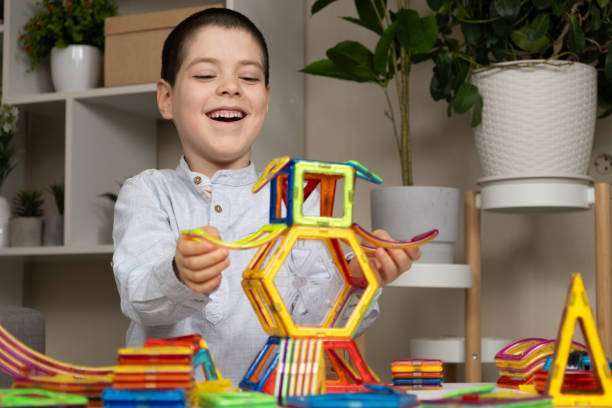
The fifth turning point: From single success to a cycle of iterative optimization.
When a child successfully builds a complex and stable structure for the first time, many people think the learning is complete. But the real turning point comes precisely after that success. The child will start trying things like, “Can it be higher?”, “Can we use fewer pieces?”, “Can we change the color?”
This iterative optimization process marks the emergence of scientific thinking. Children begin to understand that the result is not the end point, but rather something that can be improved. Each adjustment is a process of hypothesizing and verifying, even though children cannot express it verbally.
Magnetic tiles are suitable for STEM education because of their low-cost trial-and-error approach. Disassembling, starting over, and readjusting are almost effortless and stress-free. Children are unconsciously conducting fundamental engineering experiments.
The sixth turning point: From independent assembly to collaboration and expression
When children start inviting others to build magnetic tiles together , or try to explain their creations to you, STEM education has entered a higher level. Collaboration means children need to consider the ideas of others, while expression means they must organize their own thoughts.
You’ll find that when children explain structures, they begin to use descriptions such as “it’s more stable here” or “the light will be brighter this way.” Even if the language isn’t precise, it already contains underlying logical relationships. This is the rudimentary form of scientific expression, and an extremely important part of future learning.
magnetic tiles are no longer just a tool for assembling, but a medium for communicating ideas.
The seventh turning point: the shift in identity from toy to “tool”.
magnetic tiles to “solve problems” without any guidance . They might want to build a bridge for a toy to pass through, or use a structure to block out light.
At this moment, magnetic tiles have transformed from toys into tools. They are no longer just for killing time, but for achieving goals. STEM education has completed its most crucial step here: children realize that structure, materials, and design can be used to change the world.
In conclusion: True STEM education is never something that can be “taught.”
Looking back at these seven turning points, you’ll find a common characteristic: they weren’t achieved through explanation, but rather occurred naturally in the right environment. (magnetic tiles) Its power lies in allowing children to constantly explore rules, test hypotheses, and revise their understanding through play.
Once you realize the existence of these turning points, you’ll understand that the truly effective method isn’t about more complex instructional designs or magnetic tiles , but about giving children enough freedom, time, and a sense of security. Given the right environment, learning will happen on its own.
FAQ
Does a child who only builds simple shapes not yet mean they haven’t entered the STEM learning stage?
Not necessarily. Some children spend more time observing and thinking, and their turning point may come later. As long as they continue building, it means their cognition is still accumulating.
Should we deliberately explain physics or math concepts to children?
Not in the early stages. Premature conceptualization may disrupt the exploration process; it’s better to respond when children have questions.
magnetic tiles as a STEM learning tool?
Usually, it can start around three years old, but the real STEM turning point will vary depending on the child’s developmental pace. The key is the environment rather than age.