5 Key Cognitive Secrets of Magnetic Tiles : Stimulating Children’s Spatial and Logical Thinking

In a child’s development, toys are not only tools for entertainment, but also key vehicles for the development of cognitive, logical, and spatial thinking skills. Magnetic tiles , as an emerging educational toy, are gradually becoming a focus of attention for parents and educators due to their unique assembly methods, material characteristics, and color designs.
This toy not only satisfies children’s curiosity about exploring the world but also subtly promotes their cognitive development. This article will analyze the five cognitive secrets of magnetic tiles from the perspective of cognitive psychology to help parents understand their educational value.
magnetic tiles assembly: a cognitive leap from two-dimensional to three-dimensional.
magnetic tiles is to guide children through the cognitive transition from two-dimensional puzzles to three-dimensional structures through building activities. Two-dimensional puzzles directly train children’s attention, shape recognition, and basic spatial relationships.
By completing puzzle tasks on a flat surface, children first need to understand the relationships between different geometric shapes, such as how squares and triangles can be combined to form a complete pattern. In this process, children’s visual recognition abilities and graphic thinking receive foundational training.
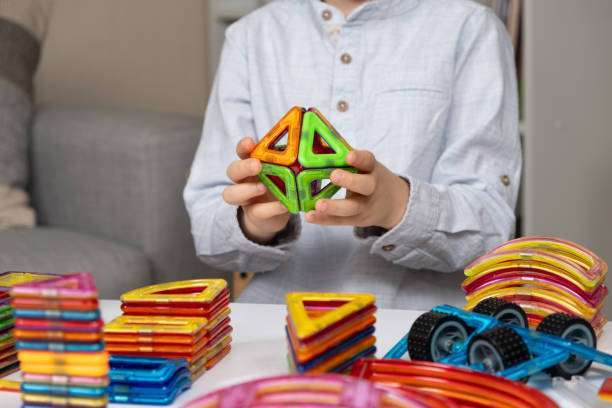
As children gradually master flat tiling skills, they will attempt to assemble magnetic tiles into three-dimensional structures, such as houses, castles, and cubes. This process demands higher levels of spatial imagination and logical reasoning abilities.
Three-dimensional tiling involves not only shape matching but also requires children to consider gravity, stability, and the structural relationships between different parts. Through such practice, children’s brains gradually develop a cognitive model of three-dimensional space, enhancing their spatial perception and logical reasoning skills.
The psychological impact of material properties and light transmittance: a comparison between ABS and PC
Magnetic tiles are primarily made of two materials: ABS and PC. These two materials differ significantly in light transmittance, impact resistance, and tactile feel, which affects children’s cognitive experience differently. ABS material is generally hard and impact-resistant, suitable for frequent disassembly and assembly and rough handling, but its light transmittance is relatively limited, resulting in a thicker color and less ability to create light and shadow variations.
PC material, on the other hand, has higher light transmittance, allowing light to pass through the magnetic tiles and creating a translucent effect, enhancing visual depth and spatial perception. It also has a smoother feel, but is relatively fragile, requiring children to handle it with extra care.
From a cognitive psychology perspective, high-transparency magnetic tiles provide children with more visual information, helping them understand concepts like light and shadow, perspective, and spatial hierarchy. During the building process, children not only observe the combination of shapes but also experience the visual effects of changing light; this multi-sensory stimulation helps enhance their observation and creativity. Furthermore, durable materials allow children to build confidence through trial and error, reducing frustration from toy damage.
Basic Education Functions: Hands-on Skills, Logical and Spatial Thinking Development
magnetic tiles is mainly reflected in three aspects: the development of hands-on skills, logical thinking skills, and spatial thinking skills. The cultivation of hands-on skills comes from children’s manipulation of the magnetic tiles—disassembling, rotating, and assembling them. During this process, children need to control their fine motor skills, which not only trains hand-eye coordination but also promotes finger dexterity. Especially in three-dimensional structure building, each precise attachment and assembly is a practice of fine motor skills.
The training of logical thinking skills stems from the process of children constantly trying, verifying, and adjusting their solutions during the building process. The design of magnetic tiles requires children to consider shape matching, structural stability, and the order of assembly during the combination process. These activities encourage children to learn planning and reasoning, and to form a preliminary awareness of cause and effect. Each successful construction of a three-dimensional structure gives children a sense of accomplishment in logical thinking, thereby enhancing their problem-solving abilities.
The development of spatial reasoning skills has a far-reaching impact. As children transition from two-dimensional to three-dimensional learning, they need to construct spatial models in their minds and engage in rotational and transformative thinking.
Magnetic tiles provide multi-angle, multi-dimensional interactive experiences, enabling children to gradually grasp the concept of three-dimensional spatial relationships. This ability not only helps in learning subjects like mathematics and physics but is also crucial for developing children’s sense of direction and spatial judgment in daily life.
Color Psychology: The Sense of Space Created by Transparency and Semi-transparency
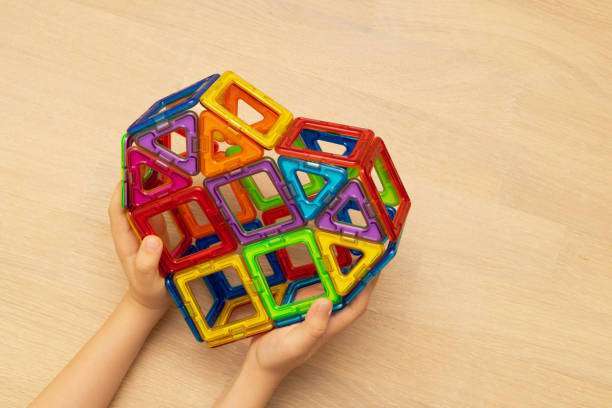
The color design of magnetic tiles is not merely about pursuing surface aesthetics; it actually contains profound psychological significance. Those transparent or semi-transparent color blocks, under the clever manipulation of light, can create an extremely rich sense of visual depth and space. This unique visual effect should not be underestimated; it helps children better perceive depth and distance, allowing them to develop a clearer understanding of spatial concepts subtly.
Carefully chosen color combinations can effectively guide a child’s visual attention, unconsciously drawing their gaze to specific areas. At the same time, these color pairings can also evoke emotional resonance in children. For example, vibrant colors like red and yellow often bring children a sense of joy and energy, making them feel exceptionally cheerful and full of boundless energy; while blue and green have a calming and balancing effect, helping children achieve inner peace and emotional stability.
From a professional perspective of cognitive psychology, color has a direct and significant impact on children’s attention, emotions, and cognitive processes. Magnetic tiles, with their colorful and translucent designs, not only make the building process more fun and add many joyful elements, but more importantly, they also help children learn to distinguish the relationships between color, shape, and space through rich visual stimulation.
While building with magnetic tiles, children gain a unique aesthetic experience through the perfect combination of color and structure, as if they are in an art-filled world. At the same time, this building activity enhances children’s understanding of complex structures, allowing them to gradually master how to construct and comprehend various complex structures through hands-on activities, laying a solid foundation for their future learning and development.
Social interaction and collaborative cognition
Magnetic tiles are not only suitable for individual play but also ideal for group activities at home or in kindergarten. During collaborative building, children need to communicate, coordinate, and assign roles with their peers, which naturally fosters social skills and teamwork. Through communication, children learn to listen, express their ideas, and adjust their strategies by observing others. This interaction not only improves cognitive flexibility but also helps children develop a sense of rules and a willingness to share.
In educational settings, teachers or parents can guide children through building activities, allowing them to collaboratively solve challenges related to structural stability and aesthetics. This combination of social interaction and cognitive activity enables children to further develop emotional understanding and social cognitive abilities, building upon their logical reasoning, spatial comprehension, and hands-on skills.
The potential for creativity and imagination to be stimulated
The open-ended design of magnetic tiles allows children’s creativity and imagination to flourish. This unique design concept contrasts sharply with traditional toys, which often have fixed ways of playing and patterns, forcing children to operate according to predetermined rules. Magnetic tiles, however, are completely different. They have no fixed limitations, allowing children to freely build and construct unique structures that reflect their inner vision, based on their rich imaginations. Whether it’s a magnificent castle, a strangely shaped vehicle, or a fantastical alien creature, anything children can imagine can be brought to life with magnetic tiles.
This process of free exploration is extremely important for children’s growth and development. It not only simply enhances children’s creativity, allowing them to fully utilize their intelligence to create unique works, but more importantly, it also stimulates their strong interest in proactive learning and problem-solving. During the building process, children will encounter various challenges and problems, such as how to make the structure more stable and how to achieve their ideal shape.
To solve these problems, they will proactively think, try, and constantly explore new methods and approaches. This proactive learning process enables children to gain a deeper understanding of the essence and laws of things, and cultivates their ability to think independently and solve problems.
Research in cognitive psychology clearly demonstrates that the experience of self-creation has a positive impact on brain development and function. It enhances the plasticity of brain neurons, making the brain more flexible and agile. During the process of self-creation, children need to use various thinking methods, such as visual thinking, logical thinking, and creative thinking, to conceive and realize their works. This multi-faceted thinking exercise helps promote the overall development of the brain and improve children’s cognitive and intellectual levels.
While building with magnetic tiles, children may constantly try different combinations. They will mix and match magnetic tiles of different shapes and colors, observing their interactions and effects. In this process, they may unexpectedly discover new structural stability or unique visual effects. Sometimes, a seemingly casual combination can produce unexpected and wonderful results. This process of trial and error and innovative exploration is like an adventure full of surprises and challenges.
It not only cultivates children’s patience and perseverance, enabling them to remain calm and determined when facing difficulties and setbacks, but also gives them a strong sense of accomplishment and self-confidence when they successfully build a satisfactory piece. This sense of accomplishment and self-confidence will become their driving force, motivating them to maintain a positive and exploratory attitude in other cognitive tasks, to dare to try new things, to constantly challenge themselves, and to pursue higher goals.
Conclusion
Magnetic tiles , as a toy that combines fun and education, offer children comprehensive opportunities for cognitive development through their unique building logic, material design, color psychology, and educational functions.
From hands-on skills to logical thinking, from spatial awareness to creativity development, magnetic tiles play a vital role at different stages of a child’s growth. Through proper guidance and interaction, parents and educators can fully utilize the educational value of magnetic tiles , allowing children to gain profound cognitive enlightenment and psychological development while enjoying the fun of building.