6 common mistakes in storing and maintaining magnetic tiles : 90% of families are slowly ruining them.

I. Why “storage method” is the real dividing line for the lifespan of magnetic tiles
In most households, magnetic tiles are considered an extremely durable toy. They have no electronic components, are shatterproof, waterproof, and lack traditional “wear and tear parts.” Because of this intuitive judgment, many parents naturally assume that, as long as they are not deliberately damaged, magnetic tiles can accompany their children throughout their childhood.
However, after three to six months of actual use, many families will notice a subtle but continuously worsening phenomenon. The magnetic tiles’ attraction weakens, requiring repeated angle adjustments during assembly; towers that were once stable begin to tilt; and when light shines through a window, a noticeable fogging or even whitish appearance appears. Some magnetic tiles’ edges begin to curl up, and the internal magnetic strips seem to have shifted.
These problems are not due to substandard product quality, but rather because most households are unknowingly causing continuous damage to magnetic tiles during storage and maintenance. The structure of magnetic tiles means that they are not “more durable the more casually they are used”; on the contrary, they are a type of structural toy that is highly sensitive to the usage environment and storage methods.
Understanding this is the first step to avoiding misconceptions.
2. Myth 1: All magnetic tiles can be casually tossed into a storage box.
This is the most common and most destructive misconception. Many families choose a plastic box, cloth bag, or drawer to simply empty the magnetic tiles after use. On the surface, this storage method saves space and makes it easy to clean up quickly, but from a structural perspective, it is continuously undermining the internal stability of the magnetic tiles.
Magnetic tiles are not solid structures. Their magnetic strips are fixed inside a plastic frame, maintaining their position through ultrasonic welding or gluing. When a large number of magnetic tiles attract, stack, and collide with each other in the storage box, the internal magnetic strips will undergo slight displacement due to repeated stress. This displacement is not immediately apparent, but it gradually weakens the alignment accuracy of the magnetic poles.
If the magnetic poles shift, the magnetic attraction between the pieces will become inconsistent in direction. Children may find it “particularly difficult to hold them together at certain angles.” This doesn’t mean their building skills have declined; rather, it means the magnetic system has become inaccurate.
Long-term random stacking can also lead to uneven pressure on the edges, especially for triangular and curved magnetic tiles, which are more prone to corner warping during stacking.
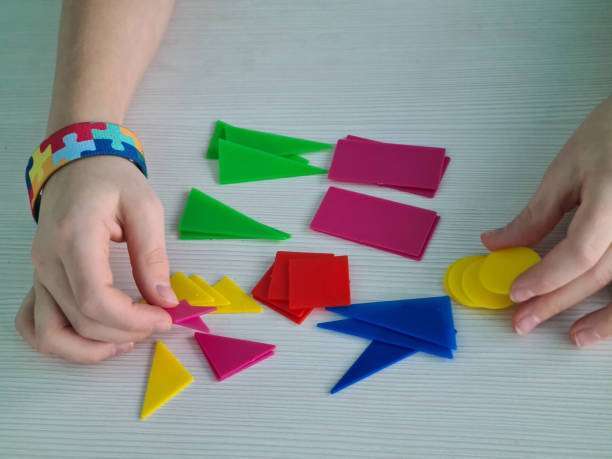
3. Misconception 2: Magnetic tiles can be placed near windows or balconies for a long time.
of magnetic tiles is the color gradation and light and shadow variations they exhibit under natural light. Because of this, many families choose to place magnetic tiles on windowsills, balconies, or other well-lit areas, allowing children to create art with light and shadow anytime.
But this is precisely the environment most unfriendly to material aging.
Most magnetic tiles are made of PC or ABS composite plastics, which are extremely sensitive to ultraviolet light. Prolonged exposure to direct sunlight can cause the plastic molecular chains to gradually break down, resulting in surface haze, color fading, and decreased light transmittance. In more severe cases, the plastic can become brittle, and the edges are more prone to developing microcracks.
In addition, temperature difference is another overlooked culprit. The area near windows experiences significant temperature variations between day and night; high temperatures in summer and low temperatures in winter repeatedly affect the internal structure of the magnetic strip. The magnetic strip and the plastic frame have different coefficients of thermal expansion, and long-term temperature fluctuations weaken the stability of the fixed structure.
This type of damage is irreversible; once it occurs, the only solution is to replace the magnetic tiles .
Fourth, misconception three: The stronger the magnetism, the more tightly they should be stored together.
Many parents, instinctively wanting to “protect the magnetism,” will deliberately stick magnetic tiles tightly together in one large piece, believing this will prevent them from scattering and reduce collisions. However, from a magnetic perspective, this long-term strong magnetic coupling will actually accelerate the decay of magnetic properties.
Permanent magnets are not truly “permanent” in the strictest sense. Scientifically speaking, magnets possess unique microstructures. When a magnet is in a closed, strongly magnetic field in a fixed direction for an extended period, its internal magnetic domains gradually change under the influence of this specific environment, slowly tending towards a single alignment. Originally, these domains possessed a relatively flexible response capability, reacting accordingly to different external conditions.
However, with the formation of this single alignment, the domains lose their original flexible response capability. It is worth noting that this phenomenon is particularly pronounced in small magnetic strips. Due to their inherent characteristics, small magnetic strips are more easily affected by the strong magnetic field in a closed state, leading to a more rapid formation of a single alignment.
The result of this single arrangement of magnetic domains is directly reflected in the magnetic tiles’ adsorption performance. At specific angles, the magnetic tiles maintain a strong adsorption force, adhering firmly. However, when the angle changes, the adsorption force decreases significantly.
Children will have a direct experience of this when building structures with magnetic tiles, feeling that the structures are “angle-dependent.” In other words, children can only successfully complete the assembly at specific angles, while at other angles, it’s difficult to keep the magnetic tiles together. It’s important to clarify that this is not a design flaw in the magnetic tiles, but rather a manifestation of magnetic fatigue. Magnetic fatigue occurs when the internal magnetic domain structure of the magnet changes, leading to alterations in its magnetic properties.
Based on the above, to avoid magnetic fatigue, a more reasonable approach is to store the magnetic tiles in a dispersed state, rather than allowing them to clump together and form high-density magnetic clusters. When magnetic tiles form high-density clusters, it’s equivalent to placing the magnet in a fixed, strongly magnetically closed state, accelerating the process of single-domain alignment and exacerbating magnetic fatigue. Dispersing the magnetic tiles reduces mutual interference between magnets, maintains the flexibility of magnetic domains, and thus preserves the good adsorption properties of the magnetic tiles.

5. Misconception 4: Wiping the surface with a damp cloth or alcohol during cleaning.
When children repeatedly touch the magnetic tiles, fingerprints, dust, or even oil stains appear on the surface. Many parents instinctively choose to wipe them with a damp cloth or alcohol wipes. While this may seem clean in the short term, it poses a very high risk from a material safety perspective.
Moisture can seep into magnetic tiles through the edge gaps , especially after repeated temperature changes, gradually reducing the seal of the welded areas. Once moisture enters, the surface of the magnetic strip is prone to oxidation, directly affecting the magnetic strength.
Alcohol-based solvents can cause irreversible chemical corrosion to the plastic surface, resulting in micro-cracks and further accelerating aging.
The correct cleaning method is to gently wipe with a dry, soft cloth, and if necessary, use a completely dry microfiber cloth, avoiding any contact with liquids.
6. Misconception 5: Mixing and storing magnetic tiles of different brands and generations.
In many families, magnetic tiles are constantly being added as children grow older. Different brands, batches, and even different magnetic strengths of magnetic tiles are mixed together in the same storage space, which seems convenient but actually creates potential structural problems.
The magnetic pole orientation and magnetic strength of different brands are not entirely consistent. When they attract each other for a long time during storage, the weak magnetic tiles will be “magnetized” by the strong magnetic tiles , and the magnetic domain alignment will be rearranged, causing the originally stable magnetic properties to become unbalanced.
In addition, magnetic sheets of different thicknesses and sizes will form irregular stress points when stacked, accelerating the deformation of the frame.
From a long-term maintenance perspective, storing items separately by brand or at least by size and magnetic strength is key to maintaining consistent overall performance.

7. Myth 6: Magnetic tiles only need “maintenance” when they are broken.
This is the most easily overlooked yet most far-reaching misconception. Many parents only realize that magnetic tile need to be “treated well” when the magnetism weakens significantly or the frame cracks. But in reality, maintaining magnetic tiles is not about repair, but about prevention.
Proper storage methods, stable environmental conditions, and gentle cleaning practices all help slow down material aging and maintain stable magnetic properties. By the time problems become apparent, the internal structure has often already undergone irreversible changes.
From an educational perspective, magnetic tiles are a type of toy that highly relies on structural stability. Once their performance deteriorates, children will repeatedly encounter failures during the building process, thereby reducing their interest in exploring complex structures. This impact is subtle, yet very real.
8. What do families who truly “cultivate magnetic tiles ” do?
Families who can keep their magnetic tile in good condition for more than three years often haven’t done anything complicated. They’ve simply avoided the aforementioned pitfalls.
When it comes to storing magnetic tiles, they carefully consider and choose between flat or compartmentalized storage methods. Flat storage allows each magnetic tile to be laid out evenly without squeezing each other; compartmentalized storage, on the other hand, neatly separates the magnetic tiles, ensuring that all parts of the tile are evenly stressed during storage, preventing damage or deformation due to excessive localized stress.
They also understand the importance of proper storage for magnetic tiles. They never allow magnetic tiles to be exposed to intense sunlight for extended periods, as the ultraviolet rays in sunlight can negatively affect the material and magnetism of the tiles.
After each use, they quickly tidy up the magnetic tiles and return them to a stable and suitable environment, such as a storage box or display cabinet with relatively constant temperature and humidity, much like letting a weary traveler return to a warm and secure home.
They have a deep understanding and appreciation of magnetism, knowing that magnetism also needs “rest.” They understand that keeping a magnetic sheet in a state of high-intensity coupling for extended periods is like putting a person in a state of high-intensity work—it will greatly deplete the magnetic force, causing it to gradually weaken. Therefore, they use magnetic sheets rationally, avoiding keeping them in a tightly coupled state for long periods.
Most importantly, they consistently viewed magnetic tiles with a rational and long-term perspective. They didn’t treat them merely as simple toys or disposable items, but rather as valuable learning tools. They believed that magnetic tiles … It can help children or users learn about spatial geometry, physical principles and other aspects of knowledge while playing, and cultivate hands-on skills and creativity, so they will take extra care to preserve and use it.
FAQ
Q1: Do magnetic tiles need to be demagnetized regularly or require special maintenance?
Under normal household conditions, demagnetization is not necessary. As long as you avoid long-term strong magnetic pressure and high-temperature exposure, the magnetic force will decay very slowly.
Q2: Can a magnetic sheet that has weakened in attraction be restored?
If it is a slight attenuation caused by magnetic domain fatigue, it can sometimes be partially alleviated by storing it in a dispersed manner and reducing high-density adsorption, but it cannot be completely restored to its initial state.
Q3: Is it better to store magnetic tiles in a child’s room or a storage room
? A room with a stable temperature and away from direct sunlight is recommended. A child’s room is fine, but long-term storage near windows or radiators is not advised.