5 Role-Based Methods for Guiding Team Collaboration with Magnetic Tiles : Boosting Children’s Social Skills

I. Why “playing with magnetic tiles together ” does not equate to “genuine collaboration”
In many homes and kindergartens, magnetic tiles are often used as a natural group toy. Children sit together, each picking up a few magnetic tiles , filling the space with the sounds of discussion and building, creating a lively atmosphere. Parents often subconsciously believe that this activity equates to teamwork, and that children naturally learn social skills in the process.
However, closer observation reveals a commonly overlooked fact: most so-called “collective building” is actually parallel play among multiple children in the same space. Each child is building their own structure, occasionally scrambling for materials or engaging in simple negotiations, but rarely truly collaborating and dividing tasks around a common goal.
True cooperation is not about having many people, but about having clear roles, aligned goals, and complementary behaviors. The reason magnetic tiles have such high value in training cooperation is precisely because they can be used to build a clear role system, naturally pushing children into a social interaction structure during the process of building magnetic tiles .
Without role definition, magnetic tiles are just building blocks. But with proper guidance, they can become a low-cost yet highly effective team collaboration training tool.
II. Why is role division more effective than “teaching children to cooperate”?
A common misconception in children’s social development is that adults often try to cultivate a sense of cooperation through verbal persuasion, such as reminding children to share, take turns, and complete tasks together. However, for most children, these abstract instructions do not automatically translate into concrete behaviors.
The value of role division lies in transforming abstract social requirements into clear, actionable boundaries. Children don’t need to understand what “cooperation” is; they only need to know what part they are responsible for and how that part affects the overall outcome.
Magnetic tiles are highly modular in structure, with distinct differences in shape, color, and function, making them ideal for assigning specific roles. These roles are not artificially imposed, but rather emerge naturally from the assembly task itself.
When children realize that the overall structure can only be established if they fulfill their own role and tasks, cooperation is no longer a moral requirement, but a necessary condition for solving problems.
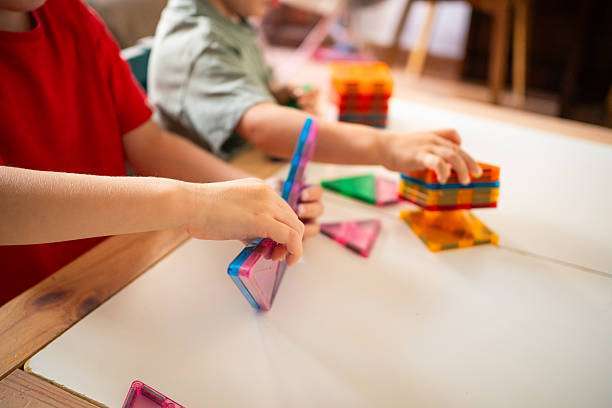
III. Role One: Structural Planner, deciding “what to build”.
In team building, the first often overlooked yet crucial role is the structural planner. This role doesn’t involve actually assembling the magnetic tiles , but rather defining the overall goal, such as whether to build a tower, an arched bridge, or a light-transmitting castle.
For children, this role is essentially about practicing expression, listening, and decision-making. Planners need to articulate their ideas so that other children can understand them, and also adjust their approach based on feedback from others.
magnetic tiles allow planning to go beyond abstract descriptions, enabling it to be accomplished by placing a few schematic pieces. This “semi-finished expression” greatly reduces the difficulty of communication, allowing children with weaker expressive abilities to participate in decision-making.
Through repeated roles as planners, children gradually realize that a good idea must be actionable, not just a figment of their imagination. This awareness forms a crucial foundation for their future teamwork skills.
IV. Role Two: Builder of the Structure, responsible for stability and connection
If planners control the direction, then structural engineers control the reality. This role directly confronts the physical properties of magnetic tiles and needs to consider how to ensure the structure is stable, securely connected, and at reasonable angles.
The builders often occupy the “core of execution” position within the team. They need to constantly communicate with the planners to confirm whether the design intent can be realized in reality. If structural instability occurs, the magnetic tile builders must propose modifications or even reject the original plan.
magnetic tiles is very intuitive; whether they are stable or not is almost immediately apparent. This gives the builder’s judgment a strong sense of real-world authority. Children will gradually understand that in a team, whether an opinion is adopted depends not on who shouts the loudest, but on whether the actual problem is solved.
This experience has a profound impact on social skills. It helps children develop a communication style based on facts and results, rather than emotional arguments.
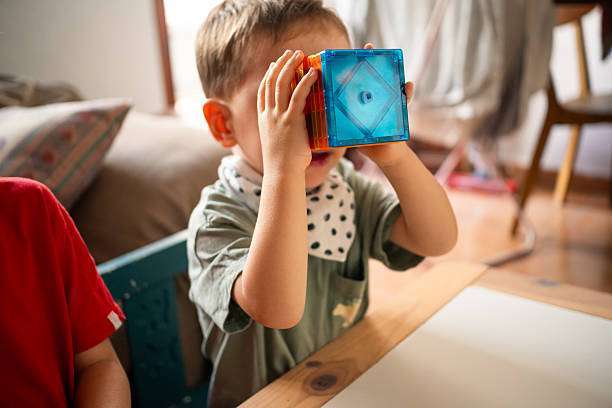
V. Role Three: Materials Manager, responsible for resource allocation
In multi-person building scenarios, the material manager is often the role with the fewest conflicts but is also the most easily overlooked. This role is responsible for organizing magnetic tiles , allocating shapes, and controlling the pace of use. These tasks may seem trivial, but they directly impact team efficiency.
For children, being a materials manager is a highly social role. It requires children to pay attention to the needs of others, rather than being solely absorbed in their own construction. Determining who needs a triangle and who doesn’t need a square for the time being requires observation and communication.
magnetic tiles , along with their distinct colors and shapes, naturally creates resource allocation issues. By guiding children to act as material managers, adults can transform potential competition into a matter of responsibility within cooperation.
When children discover that allocating materials reasonably can speed up the progress of the whole team, sharing is no longer a required virtue, but an efficient strategy.
VI. Role Four: Problem Observer, focused on identifying risks and vulnerabilities
In most children’s collaborative activities, few people are specifically responsible for “finding problems.” However, in real teams, risk identification and problem anticipation are indispensable skills.
The task of the problem observer is to continuously monitor for instability, uneven stress, or design conflicts as the structure gradually takes shape. For example, whether the tower is tilted, whether the arch is symmetrical, or whether a connection point is repeatedly loosening.
magnetic tiles allows their internal structure to be fully visible, making them ideal for training observational skills. Children can judge the structure’s state by observing changes in light and shadow and shifts in angle, rather than relying solely on intuition.
This role is particularly suitable for quiet, observant children. They don’t need to speak frequently, yet they can have a significant impact on the team through key reminders. This experience helps children build a sense of self-worth and understand that the “leader” is not the only important figure in a team.
VII. Role Five: Presenter of Results, responsible for narration and debriefing.
Once the structure is complete, many activities come to an end. But the key to truly enhancing social skills often lies in what happens after completion. The role of the presenter is to explain the design concept, the collaboration process, and the problems encountered to others.
This role requires integrating the contributions of team members and using language to transform fragmented building activities into a complete story. This greatly helps children’s narrative skills, empathy, and confidence in expression.
Magnetic tiles possess exceptional visual appeal. Their unique appearance and color combinations naturally create an irresistible attraction during displays, quickly capturing attention and drawing crowds.
When children recount their experiences with magnetic tiles, they mentally review the process, recalling who was responsible for what tasks and which important decisions were made through collective discussion. This debriefing process itself is a profound social learning opportunity, allowing children to understand the importance of teamwork and the roles different people play within a team.
After practicing this role in such situations for a long time, children will gradually learn to recognize the contributions of others in a team environment, rather than just emphasizing individual performance. They will be able to see the overall development of the team and the value of each individual more comprehensively.
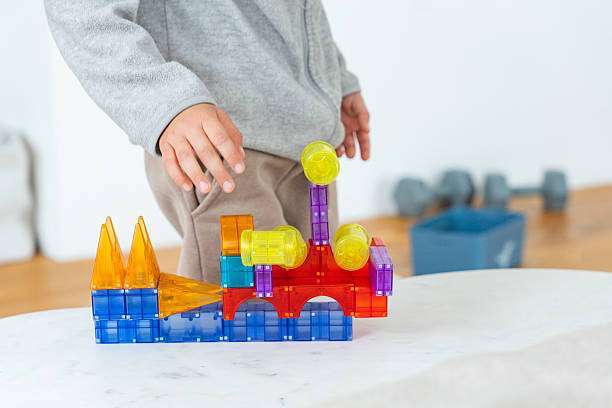
8. Role rotation is the key to a surge in social skills.
It is important to emphasize that these five roles are not fixed. The truly effective approach is to rotate roles throughout different building tasks, giving each child the opportunity to experience the responsibilities and challenges of different positions.
Through rotation, children gradually understand that teamwork is not simply a division of labor, but a dynamic balance. Every role is important, and every role has its limitations. This understanding will transfer to their future learning and life, becoming a solid foundation for their social skills.
Magnetic tiles are suitable for this type of training because they are open-ended, have no standard answers, and do not lead to frustrating consequences for “making mistakes.” Children can repeatedly try and fail in a low-risk environment, gradually developing mature cooperative patterns.
IX. The Transformation from Toys to Socialization Practice Ground
When colorful magnetic tiles are consciously used by educators or parents in children’s role-playing training, they are no longer just ordinary toys to pass the time, but are transformed into a condensed social system. In this unique system, children are as if they are in a real social environment, fully experiencing the importance of decision-making, the process of carrying out tasks, the skills of negotiating with peers, methods of conflict resolution, and the joy of sharing achievements.
It’s important to understand that these valuable abilities cannot be easily acquired through dry, tedious lectures. Empty lectures often remain at the theoretical level, failing to allow children to truly understand and grasp the essence. These abilities can only grow and mature slowly, like seedlings, through children’s genuine interactions with others.
And magnetic tiles… This provides children with an excellent practice space. The structure of this practice space is clear and easy for children to understand the rules and tasks; it provides immediate feedback, and children can quickly see the corresponding results for every action they take; and here, children don’t have to worry about incurring excessive emotional costs, and even if mistakes or conflicts occur, they can easily adjust and resolve them.
FAQ
Q1: At what age is it suitable to introduce role-playing games?
Usually around four years old, when children have basic language skills and a sense of taking turns, they can start trying a simplified version of role-playing games.
Q2: What if a child refuses certain roles?
This can be addressed through role-playing and group discussions; there’s no need to force them. The focus should be on experiencing different perspectives, not on completing a fixed routine.
Q3: Will role division restrict children’s freedom of expression
? On the contrary, clear role boundaries can often reduce conflict and allow children to exert more creativity within a safe framework.