5 insights from magnetic tiles and lighting design: Reimagining lighting in children’s spaces.

I. The Nature of Light and the Hidden Value of Children’s Space Design
In traditional children’s space design, light is often understood as a means to meet basic lighting needs. Designers determine the number, brightness, and placement of light fixtures based on room function, size, and safety regulations. In such spaces, children can clearly see the classroom walls, tabletop toys, and floor, but the potential of light goes far beyond that. Light has functions of mood regulation, attention guidance, spatial layering, and visual aesthetics; it can subtly influence children’s cognitive development and creative expression. However, this potential is often overlooked in most children’s spaces.
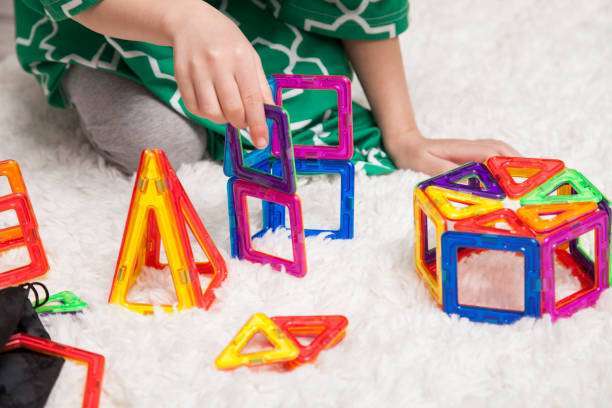
magnetic tiles offers an opportunity to reinterpret the educational value of light. These translucent, interlocking toys allow light and color to interact in three-dimensional space, creating rich visual layers and dynamic effects. When children arrange, combine, and stack magnetic tiles under light , they unconsciously observe the direction, intensity, color mixing, and changes in light and shadow. This experience far surpasses two-dimensional painting and traditional building blocks; it transforms light environment design into a manipulable educational medium, enabling children to perceive the relationship between space and light through play.
Light is not only a provider of visibility, but also a way for children to perceive the world. Studies show that children are more sensitive to light than adults; they can quickly identify differences in brightness, color layering effects, and changes in shadow shapes. This characteristic provides direction for spatial design: the lighting environment in children’s spaces should be dynamic, diverse, and interactive, allowing children to understand the relationship between light and space through independent operation, rather than simply passively receiving fixed lighting.
II. Design Inspiration for Dynamic Lighting Environments
magnetic tiles is their dynamism. In traditional spatial design, lighting fixtures and curtains are typically fixed, making it difficult to change lighting patterns with activities and creative ideas. Magnetic tiles break this limitation; they can be freely stacked, combined, rotated, and moved, allowing light and shadow to constantly change under children’s manipulation. This dynamism provides important insights for children’s spatial design: the lighting environment should not be static, but rather allow children to participate in shaping it through manipulation and experimentation.
In the experiment, when children tried to combine magnetic tiles of different colors, shapes, and thicknesses to form towers, arches, or abstract shapes, they discovered that the transmission, reflection, and shadow effects of light varied drastically depending on the combination.
A combination of red and yellow created a warm effect, while a layer of blue and green produced a calming visual experience. Through this immediate feedback, children were able to grasp the relationship between the direction, brightness, and color of light, and understand the patterns of light and shadow. Designers can apply this experimental concept to children’s spaces, using movable, translucent materials, flexible light sources, and interactive light and shadow installations to encourage children’s participation in adjusting the lighting environment, thereby enhancing the space’s fun and educational value.
Dynamic lighting not only enhances spatial engagement but also strengthens children’s cognitive abilities. As children experiment with combining magnetic tiles , they need to predict lighting effects and adjust their arrangement, a process that trains their observation, analytical, and spatial reasoning skills. Compared to fixed lighting, this interactive lighting environment better guides children to actively explore, leading to deeper cognitive development through play.

III. Applications of Color and Photopsychology
magnetic tiles provide a direct means of designing the psychological atmosphere of children’s spaces. Color and light not only affect visual effects but also profoundly influence children’s emotions, attention, and behavior. In experiments, warm colors such as red, orange, and yellow, under sunlight or artificial light, can create a lively and exciting atmosphere, suitable for play areas, drawing areas, or group activity areas. Meanwhile, cool colors such as blue and green, under lighting, can bring a sense of tranquility, conducive to reading, thinking, and quiet rest.
Children are extremely sensitive to light and color. Through the layering and arrangement of magnetic tiles , they can directly experience the effects of color mixing and changes in light and shadow. Designers can leverage this characteristic to match the lighting environment of different areas with the types of activities.
For example, a creative experimental area can use multiple layers of magnetic tiles to create rich light and shadow, enhancing the sense of stimulation in the space; while a reading area can use less light and cool-toned translucent materials to create a soothing atmosphere. This approach of designing psychological experiences through color and light is more intuitive and effective than simply relying on wall colors or fixed lighting fixtures.
Furthermore, when children manipulate magnetic tiles , they unconsciously experiment with combining different colors and observe how light and shadow change. This exploratory process itself is a process of psychological experience and aesthetic training. Children learn to understand the emotional differences brought about by changes in light and gradually become able to independently choose suitable activity areas in a space, thereby improving their self-regulation and spatial awareness.
IV. The role of light and shadow experiments in enhancing spatial cognition
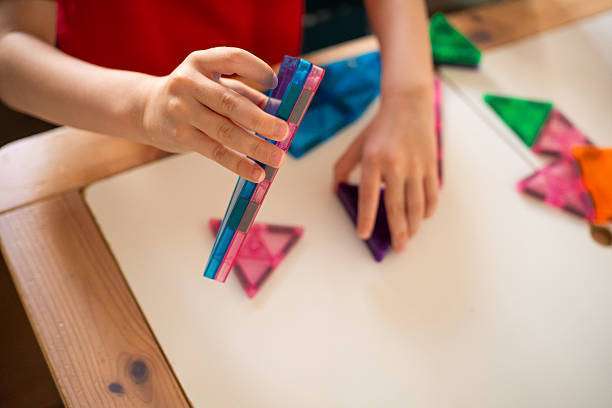
Magnetic tiles not only help children understand color and light, but also promote the development of spatial cognition through light and shadow experiments. When building multi-layered structures, arched bridges, or towers, children need to think about how to arrange the magnetic tiles to ensure structural stability, while observing how light penetrates and casts shadows. Through repeated attempts and observations, children develop an understanding of proportion, angle, perspective, and depth in three-dimensional space.
The light and shadow experiment can also cultivate children’s attention to detail and causal reasoning abilities. Magnetic tiles at different heights and angles produce different shadows, and children must constantly adjust their combinations to achieve the desired light and shadow effect.
This activity trains children’s sensitivity to spatial elements, enabling them to better observe environmental changes and analyze spatial structures in real life, and to transfer this ability to their studies in mathematics, physics, and art.
The experiment also showed that when children discovered and adjusted problems through changes in light and shadow, their problem-solving and self-learning abilities significantly improved. This suggests that designers and educators should introduce manipulable light and shadow elements into children’s spaces, which not only enhances the aesthetic experience of the space but also promotes cognitive development and creative thinking in daily activities.
V. Reconfigurable Lighting Environment and Personalized Space
The reconfigurability of magnetic tiles offers important insights for children’s space design. Compared to fixed lighting, adjustable lighting allows children to create personalized spatial experiences based on their interests and activity needs. For example, in the same classroom, children can transform a space from a creative experimentation area to a quiet reading area, or from an individual creation area to a group collaboration area, by adjusting the combination of magnetic tiles and the direction of the light source.
Reconfigurable lighting environments not only enhance children’s autonomy but also cultivate their spatial control and creativity. As children explore the relationship between light and structure, they can experiment with different combinations, adjust the position of light sources and the angle of magnetic tiles , thus actively participating in spatial design.
This experience strengthens their experimental awareness and hands-on skills, making the space an extension of learning and creation, rather than merely a place for activities.
Meanwhile, designers can draw inspiration from the principles of magnetic tiles experiments, introducing movable, translucent panels, interactive lighting fixtures, and colorful translucent materials into children’s spaces to achieve flexible and varied lighting environments. This design not only improves space utilization but also continuously stimulates children’s exploration and creativity based on different activity needs, seasonal changes, and lighting conditions.
VI. Overall Implications and Practical Suggestions
Through the magnetic tiles experiment, we can summarize several core insights into the design of lighting environments for children’s spaces. First, light should be viewed as an educational medium, not merely a lighting tool. Children actively exploring a lighting environment can understand the direction, intensity, color, and shadow of light, thereby promoting their perceptual, cognitive, and aesthetic development.
Second, the lighting environment should be dynamic and interactive, allowing children to participate in shaping light through manipulation, adjustment, and experimentation. Third, colors and translucent materials should be used appropriately to create a spatial atmosphere that meets psychological needs through combinations of light and color. Fourth, light and shadow experiments can enhance spatial cognition, observation skills, and problem-solving abilities, combining spatial design with learning and cognitive training. Fifth, a reconfigurable lighting environment can improve spatial flexibility and personalized experiences, allowing children to gain creativity and a sense of participation through independent exploration.
These insights offer a new perspective on children’s space design: the lighting environment should not be static and unidirectional, but rather an active medium for children’s cognitive, creative, and psychological development. Magnetic tiles experiments show that when children actively participate in shaping the lighting environment, their spatial understanding, aesthetic perception, and social interaction abilities are significantly enhanced.
VII. Conclusion
Magnetic tiles are not just toys, but also experimental tools for children’s light environment education. Through transparent materials, rich colors, dynamic assembly, and observation of light and shadow, children can understand the relationship between light and color, structure and space through play, cultivating spatial awareness, creativity, and psychological adjustment abilities. Children’s space designers should draw on these experimental results, using light as a medium for education and creation, guiding children to actively participate in shaping the light environment, thereby achieving the integration of learning, play, and psychological development . Practice has shown that the interaction between light and space is an indispensable part of children’s growth, providing valuable insights for the design of future children’s educational spaces.
FAQ
Q1: Which age groups of children are
magnetic tiles suitable for use in spaces ? Generally, they are suitable for preschool to lower elementary school children, especially those with basic manipulative skills and color recognition abilities. Simple combinations can be used for lower grades, while more complex light and shadow experiments can be introduced for higher grades.
Q2: How does the choice of light source affect the experimental results?
Natural light changes over time and is suitable for observing the patterns of light and shadow and color superposition. Artificial light sources can precisely control the direction and intensity, making them suitable for detailed experiments and team creation.
Q3: How should teachers guide children in experiments?
Teachers should focus on observation and guidance, providing safety tips and operational demonstrations, but should allow children to adjust the magnetic tiles and light source independently to cultivate their initiative in exploration and creation.