magnetic tiles be incorporated into art classrooms? 4 impactful teaching experiments on “transparency and light”.

I. From Toys to Teaching Tools: The Classroom Potential of Magnetic Tiles
In traditional art classes, teachers often rely on media such as paper, paint, scissors, and brushes to guide students’ creativity. Magnetic tiles were originally designed as children’s educational toys, featuring rich colors, high transparency, and flexible magnetic connections. On the surface, they seem fundamentally different from the media used in art classes, after all, they are three-dimensional and connectable, rather than flat two-dimensional tools.
However, a deeper study of its material properties and interactive modes reveals that magnetic tiles ‘ advantages perfectly align with the requirements of modern art education for “experience,” “exploration,” and “cross-media thinking.” The transparent material allows for changes in light and shadow, enabling children to expand from two-dimensional color mixing to three-dimensional optical perception; the magnetic connection allows children to continuously adjust the shape without damaging the existing structure—a kind of instant feedback and correction capability that traditional paper and pen media cannot provide.
More importantly, it inherently possesses collaborative potential. Art classes often emphasize individual creation, but as educational philosophies extend towards “project-based learning” and “team creation,” magnetic tiles can serve as a bridge for group collaboration, helping students simultaneously complete artworks through discussion, planning, and construction, thereby enhancing both their social and artistic perception abilities.
II. Experiment 1: Translucent Piecing Experiment – The Optical Charm of Color Overlay
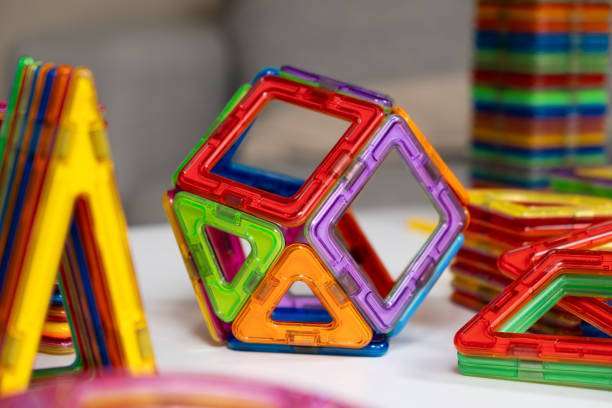
The first experiment aimed to explore the fundamental properties of magnetic tiles —transparency and light transmission. The teacher grouped magnetic tiles of different colors and had students create multi-layered structures by piecing them together. The goal was not to create fixed patterns, but to observe the effect of light passing through multiple layers of color and record the color mixing and changes.
Through this experiment, students visually discovered that red and blue combined create purple, and yellow and blue combine to create green light and shadow effects. Unlike mixing colors with traditional paints, the optical layering of magnetic tiles produces a semi-transparent effect, and the depth of color dynamically changes with the intensity of light. This instant visualization allows students to understand the relationship between light and color, thus gaining an experimental learning experience.
In the experiment, teachers encouraged students to try observing from different angles and even moving the light source to experience the impact of light transmission angle on color perception. Through this adjustment process, students not only learned the rules of color layering but also mastered the application of optics in artistic expression. This sensory feedback strengthened children’s understanding of “light” and “color,” providing a depth of experience that traditional two-dimensional media cannot easily offer.
III. Experiment Two: Three-Dimensional Experiment and Shadow Experiment – Transformation from Two-Dimensional to Three-Dimensional
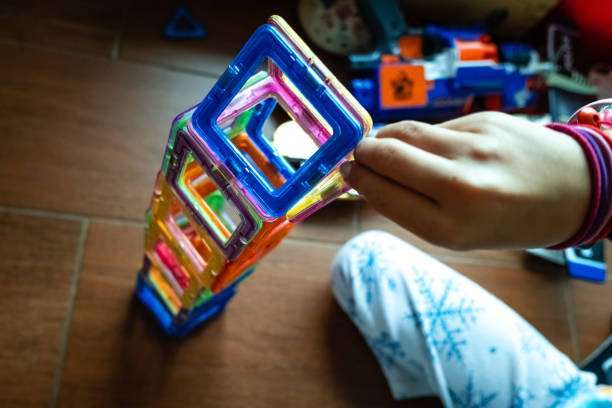
The second experiment focused on three-dimensionality and shadow effects. The teacher guided students to build towers, arched bridges, or abstract shapes of different heights using magnetic tiles , and then used desktop lamps or natural light to observe the changes in the shadows cast by the structures under the light.
During this process, students can see the light transmission effect of three-dimensional structures and the sense of layering created by overlapping shadows, thus intuitively understanding the concept of “light and shadow shaping”. Teachers can further guide students to record the changes in shadow length and angle, and try to draw shadow lines with a pen, forming a “light and shadow-painting” interactive experience.
This experiment not only enhanced students’ spatial reasoning skills but also taught them how to express visual effects through the relationship between light and structure. In traditional art education, shadow training often relies on static observation under a single light source, while the adjustability and transparency of magnetic tiles provide dynamism and interactivity for shadow experiments.
IV. Experiment 3: The Transmission and Refraction of Light – A Meeting of Science and Art
The third experiment was an extension experiment in optics. The teacher prepared auxiliary materials such as glass plates and water tanks in the classroom, guiding students to observe the phenomena of light transmission, refraction, and reflection through magnetic tiles . Students could place their assembled structures on the water surface to observe the refraction effects as light penetrated different media, and they could also observe changes in reflection and shadows under different light sources.
This meticulously designed experiment aims to guide students in understanding the changing patterns of light under different materials and angles. Simultaneously, it strives to successfully transform these fascinating scientific phenomena into highly creative artistic expressions. Throughout the experiment, the children are fully engaged in assembling various experimental devices, meticulously observing the wondrous changes in light, and diligently recording their observations. Over time, they gradually master the fundamental principles of optics and are able to consciously and skillfully utilize light and shadow effects in their own creative work, imbuing their pieces with a unique charm.
More importantly, this unique approach of intersecting science and art has ignited a powerful flame, greatly stimulating children’s deep-seated interest in exploring the unknown world. Previously, traditional art classes were often limited to simple skill training. However, through the introduction of this experiment, the art classroom has undergone a revolutionary transformation. It is no longer a monotonous and tedious place for skill enhancement, but has been transformed into an interdisciplinary experimental space full of infinite possibilities. In this space, students can achieve a perfect organic integration between sensory and rational cognition, allowing their thinking to be comprehensively expanded and enhanced.
V. Experiment 4: Team Collaborative Light and Shadow Creation Experiment – Role Division and Co-creation Experience
The final experiment introduced magnetic tiles into the team creation process. The teacher divided students into groups and assigned a themed task to each group, such as “Forest of Light and Shadow,” “Transparent Castle,” or “Abstract Light and Shadow Sculpture.” Under the teacher’s guidance, students in each group were assigned roles, including planner, builder, light observer, and presenter/narrator.
In practice, children need to coordinate the order of material use, assembly, and lighting, while observing whether the team members’ compositions conform to the overall design intent. The magnetic properties of magnetic tiles make it easy to modify the structure, allowing students to quickly try different combinations and achieve immediate feedback and corrections.
Through this team experiment, students not only mastered the skills of creating light and shadow effects, but also learned to communicate, listen, negotiate, and make collective decisions through role division and collaboration. These abilities can be transferred to daily learning and life, significantly enhancing children’s social adaptability and teamwork.
The Educational Value of Magnetic Tiles Based on Experimental Results
The results of four experiments show that magnetic tiles can realize educational potential in art classes that goes beyond traditional toys. Their translucency and magnetic properties allow children to gain in-depth experiences with color, light and shadow, structure, space, and teamwork. They are not only a medium for visual art but also a bridge between scientific experiments and social training.
Of particular note is that in the team collaboration experiment, teachers observed that children actively discussed structural stability, lighting angles, and color matching. This behavioral pattern proves that magnetic tiles can transform abstract artistic concepts into concrete operations, allowing children to gain intuitive understanding through hands-on practice.
Meanwhile, the openness and reconfigurability of magnetic tiles significantly reduce potential student frustration in the classroom. During classroom practice, even if the final product doesn’t perfectly match their initial expectations, students can flexibly adjust it without disrupting the original structure. This allows students to continuously experience success; each small adjustment and improvement brings the work closer to their ideal. This sense of accomplishment acts as a catalyst, motivating students to be more actively engaged in learning and effectively enhancing their learning motivation.
VII. Suggestions for Introducing the Concept into the Classroom
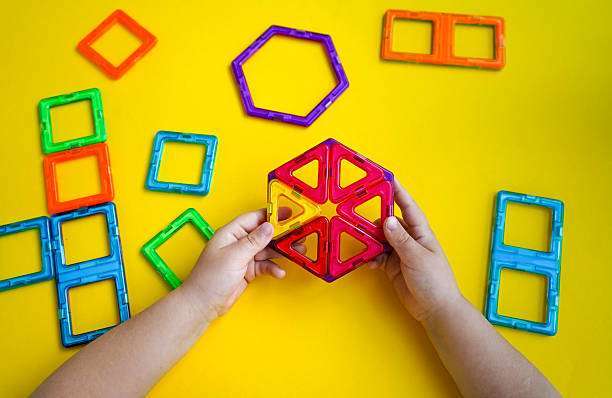
First, teachers should design tiered experimental tasks based on the age and ability level of the class. Lower grades can start with color layering and simple three-dimensional structures, while higher grades can incorporate tasks involving optical principles and teamwork.
Secondly, storage and organization are equally important. Magnetic tiles should be stored according to color and shape to ensure the smooth conduct of the experiment, while also cultivating students’ organizational habits and sense of responsibility.
Third, teachers need to act as guides rather than operators. Let children try to build independently, observe changes in light and shadow, and summarize patterns through discussion. This approach can stimulate children’s interest in independent learning, rather than relying on teacher instructions.
Finally, safety awareness cannot be ignored. Although magnetic tiles are safe, the risk of falls still needs to be considered in experiments on tall towers or high-rise structures. Teachers should provide stable tabletops or mats and clearly define the boundaries of the experimental area.
VIII. Future Prospects: Interdisciplinary Applications of Magnetic Tiles
Through four experiments, we can foresee that the potential of magnetic tiles in education extends far beyond art classes. They can serve as a STEAM education tool, integrating art, physics, engineering, and teamwork. Teachers can combine light and shadow experiments with mathematical geometry to explore the stability of triangular structures; or integrate them with physics lessons to explain the principles of magnetism, light refraction, and light transmission.
In interdisciplinary courses, magnetic tiles enable students to “learn by doing,” understanding complex concepts through intuitive manipulation. This experiential learning helps enhance cognitive depth and cross-disciplinary thinking skills. At the same time, the open-ended material provides space for personalized creation, allowing students to develop unique works through free exploration and strengthening their self-expression.
magnetic tiles The introduction of this approach is expected to promote the transformation of classroom teaching from one-way instruction to interactive inquiry, making art education more vivid, concrete, and diversified.
FAQ
Q1: What age group is
magnetic tiles suitable for in art classes ? Generally, it’s suitable for children in the lower grades of elementary school and above, who already have basic color recognition and manipulation skills. Tasks can be simplified for lower grades, while optics and spatial experiments can be introduced for higher grades.
Q2: How long does each experiment take?
A single basic light-transmitting assembly experiment takes 20-30 minutes, and a three-dimensional light and shadow and team collaboration experiment takes 40-60 minutes. The time should be adjusted according to the number of students in the class and the complexity.
Q3: What to do if magnetic tiles are worn out or missing?
Regularly inventory them by color and shape, and prepare a small number of spare magnetic tiles to ensure the smooth running of experiments. If too many tiles are lost, replace them in batches to avoid affecting the learning experience.