Understanding the 6 Core Structures of Building Mechanics: The Truth About Arches, Towers, and Triangular Bracing Magnetic Tiles

Why magnetic tiles are the best entry point for children to understand structural mechanics
In most people’s minds, structural mechanics is an abstract, mathematically-oriented, and engineering-focused discipline, seemingly only found in university classrooms or professional blueprints. However, true structural mechanics doesn’t begin with formulas, but rather with the intuitive question of “why doesn’t the structure collapse?” Magnetic tiles provide an almost perfect environment for this initial introduction to mechanics. They are neither a soft toy where you can simply stack tiles to succeed, nor are they as unforgiving as real construction, but rather lie somewhere in between, amplifying and showcasing the stability and imbalance of structures.
When children build with magnetic tiles , gravity, support, and force distribution are not hidden. On the contrary, a single misplaced step can cause the structure to collapse immediately; adjusting the angle can significantly improve stability. This instant feedback makes structural mechanics no longer knowledge to be explained, but a “fact to be experienced.” More importantly, the transparency and light transmission of magnetic tiles allow the internal relationships of the structure to be directly seen, and the force transmission path is no longer an abstract concept, but a real existence in space.
Understanding these six core structures is not about helping children memorize names, but about helping them gradually develop an intuitive understanding of structural mechanics through repeated assembly. True learning only begins once this intuition is established.
The first type of core structure: the actual location of the vertical tower structure and the center of gravity.
Almost every child’s first attempt is to “build higher.” Tower structures are the most natural yet most challenging form of magnetic tile building. They seem simple—just stacking tiles upwards—but they are also the easiest to fail at. Each collapse serves as a reminder of a crucial fact: height itself isn’t the problem; the center of gravity is.
As the tower grows taller, children will discover that the stability of the base becomes exceptionally important. Even a slight shift in the base will cause noticeable wobbling at the top. This experience gives children their first direct understanding that the center of gravity isn’t at the top, but rather determined by the overall structure. The lightweight nature of magnetic tiles makes changes in the center of gravity even more sensitive, amplifying even the smallest asymmetry.
Through continuous experimentation, children often spontaneously make adjustments, such as widening the base, gradually narrowing the upper layers, or adding side supports. These actions are essentially performing structural mechanics-based center-of-gravity control and load distribution optimization, only they are not named. The first mechanical truth that tower structures teach children is that stability is not achieved through “force,” but through “layout.”

The second core structure: triangular support and irreplaceable stability.
When children repeatedly fail to build a tower, they often inadvertently discover a magical phenomenon. Simply adding a slanted magnetic piece to the side suddenly makes the structure much more stable. This is precisely the moment when the triangular support structure comes into play.
In structural mechanics, the triangle is considered the most stable basic unit because once its shape is determined, it is almost impossible for it to deform without changing its side lengths. Magnetic tiles, through magnetic connections, transform this abstract principle into a tangible and verifiable fact. When children try to use squares or rectangles as supports, the structure easily deforms; but once a triangular structure is added, the wobbling immediately decreases.
More importantly, children will discover that you don’t need many triangular supports; placing them in key positions can significantly improve overall stability. This helps them gradually understand that architecture isn’t about piling up materials, but about structural design. The truth about triangular supports is that they aren’t for aesthetics, but to ensure a clear path for the transmission of forces.
The third core structure: arch bridge structure and pressure redistribution
The arch structure is one of the most counterintuitive types of magnetic tiles . Many children initially believe that a structure without a central support will inevitably collapse. However, when they try to build an arch using curves or polygons and discover that it can actually bear weight, the cognitive impact is very strong.
The reason arch bridges remain stable is not because their central section is particularly strong, but because the pressure they bear is cleverly transferred to their sides. Magnetic tiles provide us with an excellent window for detailed observation.
Because magnetic tiles are transparent, children can clearly see the specific connections between each magnetic tile and clearly observe how the force is transmitted to the ground along the arched structure.
Through continuous attempts to build, children will gradually realize that the closer an arch bridge is to a complete arc, the more stable its structure becomes; and once the shape of the arch is destroyed, the entire structure of the arch bridge will quickly lose its balance.
This hands-on experience allows children to deeply understand that structural mechanics is not as we imagine, where “the greatest force is applied means the most important place,” but rather “how the force is guided” is the key.
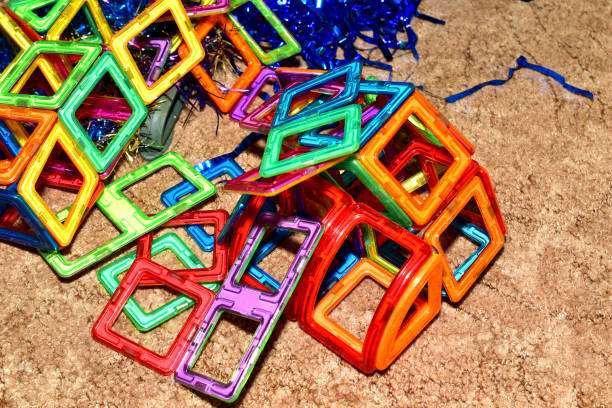
The fourth core structure: framework structure and overall synergy.
As the scale of the puzzles gradually increases, children will naturally enter the stage of exploring frame structures. A frame structure is not a single form, but a holistic system composed of multiple vertical and horizontal components. At this stage, magnetic tiles begin to demonstrate their true engineering value.
Children will discover that a single wall is easily toppled, but when multiple walls are connected to form a whole, the stability increases exponentially. This is because the magnetic tile frame structure allows each component to share the load, rather than bearing it independently. When one part is affected by external forces, the others can compensate.
This concept of overall synergy is a core idea in structural mechanics. Through the assembling experience, magnetic tiles help children intuitively understand that “the whole is greater than the sum of its parts.” They will begin to think about the relationships between structures, rather than just focusing on whether individual components are sturdy.
The fifth core structure: the art of balancing cantilever structures and forces.
Cantilever structures are often a challenge that children spontaneously attempt after becoming familiar with basic stable structures. The outward extension and lack of ground contact with the ground are inherently appealing. However, cantilever structures are also among the easiest to fail at because they require extremely high levels of force balance.
While building with magnetic tiles , children will discover that simply extending outwards will quickly cause the whole structure to collapse. To make the cantilever successful, it is necessary to add counter-supports from the inside or to add weight from the back. This experience helps children understand for the first time that forces exist in pairs, and that every outward force requires an inward balance.
Cantilever structures elevate structural mechanics from “stability” to “balance.” Children are no longer simply preventing collapse, but actively designing the interplay of forces. This shift in understanding is a significant marker of the maturing of engineering thinking.
The sixth core structure: the complexity of composite structures and real-world architecture.
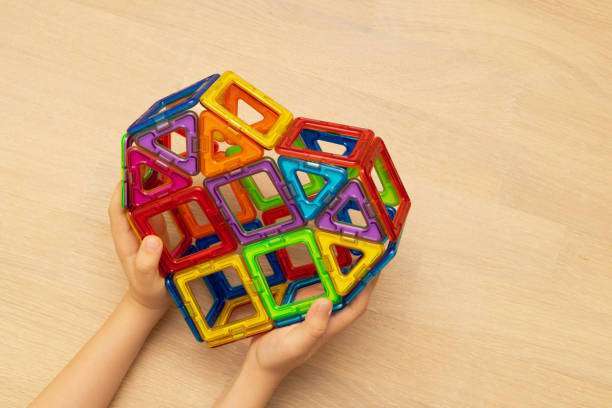
Once children are proficient in using the previous structures, combined structures will naturally emerge. Towers, triangular supports, arches, frames, and cantilevered structures are no longer isolated entities but are integrated into the same building. At this stage, magnetic tiles truly simulate the complexity of real-world architecture.
As children explore, they will gradually discover that in reality, no single structure can solve all the problems they may encounter. When faced with the need for magnetic tiles in high-rise buildings, a tower-like structure that provides vertical stability is required, as this is the only way to ensure the stability of the building at a height and prevent it from easily tilting or collapsing. In the middle of the building, a frame structure is needed to achieve the synergy between the various parts. The frame can tightly connect the components together and jointly bear the forces from different directions.
In situations involving large spans, arched structures can effectively distribute pressure evenly. At the building’s edges, cantilever designs may be necessary to expand usable space without requiring excessive additional supports. This demonstrates that structural design is no longer a single solution; it necessitates weighing and selecting among different needs and conditions.
This way of thinking, which combines different structures according to actual conditions, is precisely the true face of architectural mechanics. In the world of architectural mechanics, there is no such thing as a perfect structure, because every structure has its own advantages and limitations. Only the structural solution that suits the specific situation is the best choice.
Magnetic tiles offer children a great platform for exploration in a low-risk, high-reward way. As children build with magnetic tiles, they experience failures and adjust their plans. Through this iterative process, they gradually grasp the important principles of structural selection and combination in building mechanics.
Conclusion: Mechanics is not formulas, but observed laws.
Through magnetic tiles The greatest value of understanding structural mechanics lies not in learning a lot of terminology, but in developing an intuitive judgment of structural stability. Arch bridges are not mysterious, towers are not built by luck, and triangular supports are not mere decorations. They exist because forces must be guided rationally.
When children repeatedly witness magnetic tile structures collapse, adjust, and stand up again during the building process, they are learning about structural mechanics with their bodies and eyes. Once this learning occurs, they will have a solid cognitive foundation for future interactions with real buildings or for more systematic scientific learning.
FAQ
If a child can’t build an arch bridge, does it mean they lack comprehension?
Not necessarily. Building an arch bridge requires a high degree of fine motor control and patience. Failure is part of the learning process, and multiple attempts are more important than a single success.
Should we explain the mechanical principles behind each structure to children?
No, it’s not necessary at the beginning. Let children develop an intuition through building first, and then explain based on their questions; their understanding will be much deeper.
magnetic tiles really replace professional architectural models?
They can’t completely replace them, but in the early stages, their low barrier to entry, high feedback, and safety are advantages that no professional model can match.