Magnetic Tiles: 5 Steps to Boost Psychological Resilience – The Courage to Try Again After Failure

I. Why Children’s Psychological Resilience Lies in Play
Magnetic tiles, with their lightweight, transparent, colorful, and magnetic structure, have become an ideal medium for early childhood and children’s psychological development. Unlike electronic toys that replace children’s thinking, or overly complex building blocks that require advanced skills, they allow children to explore the world with their hands, eyes, and hearts in a way that suits their developmental stage. During the building process, magnetic tiles may experience instability, incorrect adhesion angles, or shifts in the center of gravity; these minor setbacks become gentle touchpoints for developing resilience.
Through the game of magnetic tiles , children continuously experience a cycle of anticipation, attempt, failure, adjustment, rebuilding, and completion. Each collapse tells children that failure is not the end, but a new beginning; each rebuild strengthens their psychological resilience in the face of setbacks. When children can maintain focus and be willing to continue trying in the ever-changing process of building, it means that the seeds of psychological resilience have been quietly planted deep within their hearts.
Therefore, using magnetic tiles as a vehicle for resilience training is not a coincidence, nor is it an overemphasis; rather, it is determined by their inherent structural characteristics, operation methods, and inherent uncertainty. This “resilient” toy allows children to truly learn to face failure and try again in a safe, free, and repeatable environment.
Second, let children experience “minor failures” to reduce their oversensitivity to setbacks.
Psychological research indicates that children’s fear of failure often stems from two types of experiences: one is the overwhelming negative emotions that failure brings, such as the loud sound of building blocks collapsing or malicious criticism; the other is the inability to repair the damage after failure, such as an overly complex structure that a child cannot adjust independently. Magnetic tiles precisely avoid these pitfalls. Their lightweight material does not produce frightening sounds when they collapse, and the transparent sheets do not produce a sharp impact when they fall. This mild form of failure allows children to experience setbacks without being overwhelmed by emotions.
A child’s willingness to try again is greatly influenced by the intensity of their first failure. Magnetic tiles offer “minor failures,” allowing children to realize that failure is not dangerous and won’t damage their confidence. They don’t feel threatened by the structure collapsing, and this sense of security is the primary foundation for building resilience. As children gradually become accustomed to these minor failures, they are more willing to continue trying and exploring.
In the world of magnetic tiles , failure means new possibilities, not the end; it means adjustment, not stopping. Children learn not fear of failure, but tolerance for it and psychological stability in the face of the unknown. The role of parents and teachers in this process is not to help children avoid failure, but to make failure acceptable, discussable, and repairable, allowing children to face setbacks in a relaxed atmosphere that they might instinctively resist.
This experience of mild failure lays the first cornerstone of resilience. As children gradually become less afraid of failure, their psychological system prepares them for the next step of independent attempt. Many problems in the developmental process arise from children’s oversensitivity to failure. Through magnetic tiles training, children gradually understand that failure is not synonymous with a lack of ability, but rather a natural learning process.
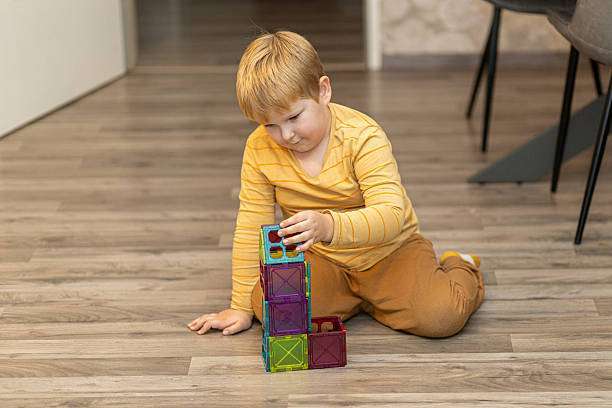
Third, foster a sense of control through proactive attempts, helping children realize “I can do it.”
The core of resilience lies in a sense of control, which is a child’s understanding of the consequences of their actions. They need to know that they can influence the course of events. When children are able to adjust, test, and verify their ideas through play, they develop an inner strength: I can change the outcome.
Magnetic tiles offer children ample opportunities for experimentation. They can change the angle, replace the tiles, adjust the bottom support, and try different combinations of colors and sizes. This hands- on approach allows children to see different results with each attempt. When they succeed, they feel proud; when they fail, they can quickly review their progress. This immediate feedback helps them gradually develop a sense of cause and effect, thus gaining a sense of control.
This sense of control is extremely valuable because it prevents children from giving up easily when faced with setbacks. Once children understand that “problems can be solved by me,” they will be willing to keep trying. The essence of resilience is not the absence of failure, but maintaining the drive to move forward even after failure. Building with magnetic tiles makes this process natural, easy, and repeatable.
Through active experimentation, children learn how to cope with uncertainty. The magnetic attraction is always present, but it doesn’t guarantee an ideal structure every time. By trying different methods, children discover which construction techniques are more stable, which combinations are more prone to failure, and which angles are best suited for forming large structures. This exploration brings not only cognitive experience but also the growth of psychological abilities.
Fourth, cultivate perseverance through repeated “collapse and reconstruction,” helping children get used to continuing to move forward after failure.
Perseverance is a crucial component of resilience, determining whether a child can maintain their effort when faced with challenges, rather than giving up easily. Magnetic tiles , as a structural toy, inherently contain a cycle of failure. Any seemingly stable structure can collapse when a new part is added, and any carefully constructed tower can fail due to instability. For a child, each collapse represents a psychological fork in the road: to stop, or to continue trying?
The advantage of magnetic tiles lies in making it easier for children to choose to “keep trying.” First, the sound of them collapsing is quiet and won’t frighten children. Second, the magnetic tiles don’t scatter too far, making reconstruction inexpensive. Third, children can see how their efforts affect the improvement of the structure. These factors combined make the collapse less of a setback and more of a prompt, reminding children to adjust their strategies.
Children learn the importance of perseverance through repeated rebuilding. They learn patience and how to remain calm in the face of failure. This process involves several psychological stages. Initially, they may feel frustrated or even cry due to failure; then, they may try to seek help from adults; subsequently, they begin to attempt to repair the magnetic tiles themselves ; finally, they look forward to the challenge and experience the joy of solving the problem.
In this process of psychological transformation, magnetic tiles are a crucial part of cultivating resilience. As children overcome their fear of failure and gradually enjoy the process of achieving results through perseverance, their inner psychological system becomes stronger. Perseverance is no longer driven by compulsion or task requirements, but by the child’s understanding that effort can bring about change.
In this cycle of magnetic tiles collapsing and rebuilding, children gradually develop a stable psychological understanding: failure doesn’t stop me from moving forward; it’s just the beginning of a better attempt. It is this sustained ability that makes them more resilient and adaptable when facing academic pressure, interpersonal conflicts, and challenging tasks in the future.
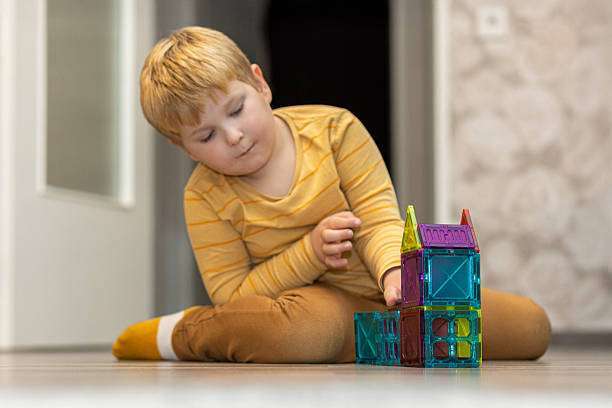
Fifth, children can regulate their emotions through light, shadow, and color, and learn to maintain a stable mindset in the face of setbacks.
Resilience is not merely about continuing to try at the behavioral level, but also includes the ability to maintain psychological stability after setbacks. Emotional regulation is a key component of psychological resilience, and the transparent design and light-and-shadow properties of magnetic tiles provide a unique environment for cultivating this ability.
Magnetic tiles display soft and rich color variations under different light sources, often captivating children during the building process. When they focus on the interplay of light and shadow, their brains enter a state of mild immersion, similar to meditation. This immersion can reduce emotional fluctuations, allowing children to quickly recover from setbacks.
transparent magnetic tiles creates a sense of visual order and beauty for children, which in itself is a form of emotional soothing. When the structure collapses, children are not completely overwhelmed by the frustration of failure, but are easily drawn back to the colors and light, and become engrossed in rebuilding. This visual restart mechanism is an important way to stabilize emotions.
Magnetic tiles also allow children to express emotions through color. Different colors represent different psychological reactions, and children are actually expressing their feelings when choosing colors for magnetic tiles . For example, when children choose to build structures with bright colors, it may mean they are in high spirits; when they tend to arrange them in monochromatic patterns, they may be looking for an outlet for emotional stability. This nonverbal expression of emotion is especially important for young children because they often cannot clearly describe their feelings.
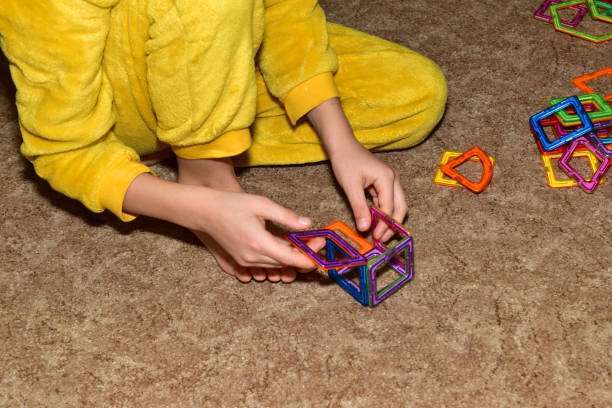
Sixth, provide support through cooperation and interaction, helping children understand that setbacks are not a burden they bear alone.
Resilience is not only a personal skill but also a social one. Children learn support, understanding, sharing, and communication through collaboration, and these skills directly influence their emotional attitudes when facing difficulties. Magnetic tiles are toys with great potential for collaboration in educational settings. They allow children to express themselves and experience support while building together.
In collaborative building, children will encounter situations such as arguments, differing opinions, or structural failures. Every conflict is an opportunity to learn cooperation, and every joint adjustment is a process of understanding and support. When the structure collapses, children will discover that they are not the only ones who fail; other children will experience the same setbacks. This shared failure and joint effort can significantly reduce children’s shame about failure and increase their courage in the face of difficulties.
In cooperative games, children naturally develop roles: some design, some build, and some observe stability. Through this process, they learn how to express opinions, listen to others, and coordinate their thinking. Especially when structural problems arise, children discuss solutions together, providing them with ample opportunities to practice communication under pressure.
Adults can also help children identify and regulate their emotions in a positive way when facing setbacks through companionship and guidance. For example, when a structure collapses, adults can encourage children to express their feelings and offer emotional acceptance. Children who are accepted are more likely to recover from failure and are more willing to continue participating in cooperation.
Gaining support through social interaction is one of the most effective ways to enhance resilience. Through the collaborative experience of magnetic tiles , children gradually develop an inner belief that difficulties are not something to be faced alone, and that failure does not lead to isolation. This belief will give them more courage to seek help when facing challenges in the future, and will also make them more psychologically stable under pressure.
VII. Conclusion
Developing resilience is a gradual process that requires children to accumulate experience through continuous attempts, failures, and successes. Magnetic tiles , as a toy with semi-controllability, reconstructability, and visual appeal, provide an ideal environment for this process. They help children reduce their fear of setbacks through minor failures; build a sense of control through proactive attempts; cultivate perseverance through collapse and reconstruction; achieve emotional regulation through light and color; and feel supported through cooperation and interaction.
These seemingly simple experiences actually constitute important psychological resources for children to face the complexities of the world in the future. Resilience is not innate, but can be shaped through environment and experience. Magnetic tiles make the cultivation of resilience no longer an abstract goal, but a real experience that happens at children’s fingertips. When children can put together magnetic tiles again after failure , when they can self-regulate in the face of setbacks, and when they gain strength through cooperation, they already possess the inner courage needed to step into a larger world.
In this era of constant change, what’s more important than knowledge is the mindset to face the unknown, and what’s more important than skills is the ability to get back up after a fall. Letting children practice resilience in the world of magnetic tiles is paving a solid yet flexible psychological path for their complex future lives.