
I. Starting with “Attraction”: Why magnetic tiles can capture children’s attention?
Magnetic tiles are an educational toy that combines magnetism, light and shadow, and structural design. Its charm lies in its “simple yet dynamic” design; a few transparent, colored magnetic tiles shimmer in the sunlight, capable of both laying flat to form patterns and adhering to create three-dimensional shapes. Sensorially, it offers both visual appeal and hands-on interaction. Through repeated building and disassembly, children not only satisfy their creative desires but also subtly develop spatial logic and concentration.
Many parents ask, “At what age can children start playing with magnetic tiles?” Actually, this toy has a wide range of applications; children can start trying it from around two years old. However, the way they play and the learning focus should change according to their age. Children at different stages experience completely different cognitive development when playing with magnetic tiles .
II. 2-3 years old: The initial stage from tactile exploration to graphic cognition
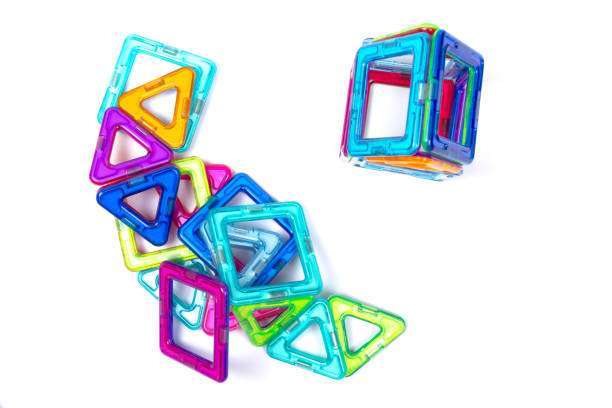
Two- or three-year-old children are in a sensory-dominated stage. They love to touch, grasp, and tap anything that makes a sound or reacts. The appeal of magnetic tiles at this age mainly stems from the magical property of “magnetic attraction.” When children see two magnetic tiles “attracting each other by themselves,” they feel surprised and curious and begin to realize that “invisible forces” can also bring about change.
During this stage, parents can play “magnetic tile matching” games with their children. For example, they can have the children put together magnetic tiles of the same shape and color or let the children freely attract and absorb the tiles, experiencing the process from disorder to order. Parents don’t need to emphasize “what they will build,” but rather let the children naturally develop the concept of “shape” through sensory exploration. By observing the color changes as light passes through the stained-glass tiles, they will gradually recognize the differences in color, brightness, and transparency.
III. Ages 4-5: The Emergence and Foundational Construction of Spatial Imagination
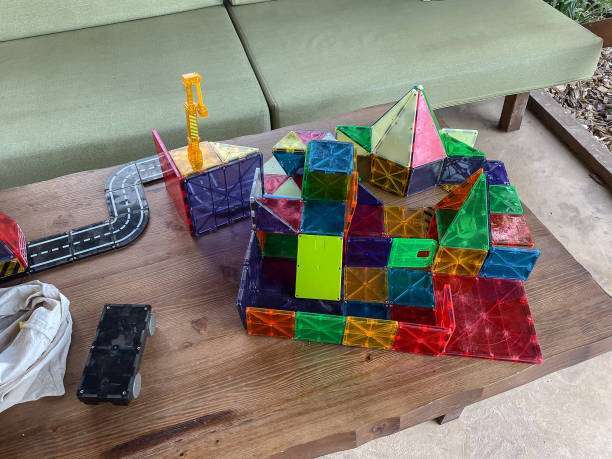
By the age of four or five, children begin to develop a basic understanding of structure. They will try to build “towers,” assemble “houses,” and even simulate complex shapes such as bridges and vehicles. At this stage, magnetic tiles are not only toys but also “spatial training tools.”
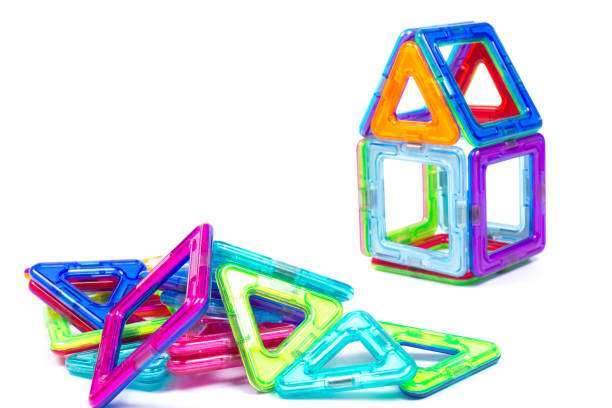
Parents can guide children from two-dimensional to three-dimensional building. For example, start by building a cube, then add a roof structure to help them understand the relationship between the “bottom,” “side,” and “support.” Children will repeatedly try and fail in this process—the tower will fall, the roof will collapse—and each failure is a training exercise in spatial logic.
In addition, children at this stage have a stronger subjective perception of color, so they can try thematic construction games: build a “sun city” with warm colors and a “snow house” with cool colors. These activities not only train imagination but also strengthen the early formation of color matching and aesthetics.
IV. Ages 6-8: The Period of Integration Between Logical Construction and Creative Expression
After entering primary school, children begin to develop a sense of rules and systematic thinking. At this stage, the role of magnetic tiles gradually shifts from “learning through play” to “creating through learning.” They are already able to understand geometric relationships, know that triangles are more stable and cubes have six faces, and can actively plan structures while building.
The focus at this stage is on “logic and creativity in parallel.” Parents can encourage children to build themed structures, such as a “transparent city” or a “future transportation hub,” having them first draw a sketch and then bring it to life using magnetic tiles. This not only develops their hands-on skills but also cultivates project thinking and problem-solving abilities. If possible, observing stained-glass projections under natural or artificial light can help children understand the principles of light transmission and reflection, enhancing their scientific interest.
V. Ages 9 and up: The transition from toys to creative tools
Children aged nine and above have often entered the stage of abstract thinking. Their interest in magnetic tiles no longer stops at “building” but shifts to “creating.” At this time, magnetic tiles can be redefined as “building materials” or “creative media.” They can combine them with cardboard, LEGO, and even small lamps to create complex models or dynamic display works.
The focus of this stage is on openness and interdisciplinary application. For example, children can use magnetic tiles with mirrors to observe geometric symmetry or use a tablet to film the building process and create a time-lapse animation of “structural transformation.” This kind of independent exploration allows children to move naturally between scientific, artistic, and design thinking.
VI. The role of parents: guiding rather than dominating
Regardless of age, parents should adhere to a core principle when playing with their children: “guide, not dominate.” Children’s exploration is often disordered, and the learning value of magnetic tiles is precisely revealed in this seemingly random process. Parents can ask open-ended questions, such as, “What if you changed the color?” or “Do you think this is stable?” to guide children’s thinking, rather than directly giving them the answers.
In addition, encouraging children to record their work or take photos to preserve it is also a form of feedback on their growth. By comparing their work at different stages, they can visually see their progress, enhancing their sense of accomplishment and self-expression.
VII. Conclusion: The Growth Trajectory of a Magnetic Disk
Magnetic tiles witness the entire process of a child’s hand-eye-brain coordination development. At two years old, they perceive the world; at four, they attempt to construct; at six, they begin to plan; and from nine onwards, they use magnetic tiles to express their ideas.
Its significance has long transcended the toy itself, becoming a “structural language” for children’s cognitive development. As long as parents are willing to patiently accompany them, the magnetic tiles can be used to build the entire world in their children’s imagination.