4 Light and Shadow Observation Experiments on Magnetic Tiles : The Difference in Light Transmission at Different Times is Astounding

I. Morning Light and Shadow Experiment: Soft Transmittance Changes Under Low-Angle Light
The morning light is the gentlest, most delicate, and most suitable time of day for observing the changing light and shadow with magnetic tiles . As the sun just rises above the horizon, the light enters the room at a very low angle, its brightness not yet fully developed, and its cool color temperature with soft scattering creates a hazy, dreamlike effect on the transparent structure. A
t this time, the magnetic tiles don’t exhibit the high contrast and saturation of midday; instead, they appear as if veiled in a light mist, making all colors appear delicate, translucent, and subtly layered.
When children observe magnetic tiles during this time , their first notice is often not the colors themselves, but rather the “elongation” of the shadows. Due to the low angle of the light, the shadow of any magnetic tile structure will appear multiplied, creating an exaggerated extension effect.
A small square tile can project a long, thin shadow onto the floor. Children often move their bodies following the direction of the shadow, and as they move to observe, they are amazed to discover that the direction and length of the shadow change accordingly with their position. From this moment on, they unconsciously establish a correspondence between the directionality of light and the shape of the shadow, which is an important starting point for developing physical thinking.
The soft brightness of morning light allows the layering of transparent tiles to create a more gradual and gentler blend. If blue and yellow are layered, the green a child sees isn’t the bright, vivid green of midday light, but rather a softer, grayish-green. This allows children to see the “process” of color mixing more clearly, rather than just the final result. Many children, through this light, will realize for the first time that color layering isn’t instantaneous, but rather varies in degree depending on the intensity of the light. This experience is difficult to achieve with traditional paper drawing, but can be easily presented with magnetic tiles .
Furthermore, the morning light is ideal for observing the refraction of structures. Transparent tiles, under oblique light, produce subtle light reflections that appear as blurred bands of color on the floor or tabletop, changing direction as the angle of the light changes. Children will touch these “light marks,” and although they are not physical objects, this very act demonstrates that they are trying to understand how light exists. For children, light is a special “material” that they can see but cannot touch, and magnetic tiles help them experience light as an “element” in play for the first time.
Early morning is a time of emotional stability and heightened observational skills. Children have just recovered from sleep and haven’t yet engaged in vigorous activity; their senses are at their most natural state. Observing light and shadow at this time not only helps them understand the relationship between light and objects but also allows them to reconnect with the world in a calm and slow-paced way. For sensitive children who need a slower pace, such light and shadow experiments are especially effective in stabilizing their emotions, cultivating patience, and gradually improving their ability to observe details.
II. Midday Light and Shadow Experiment: The Color Explosion and Detail Magnification Brought by Strong Direct Sunlight
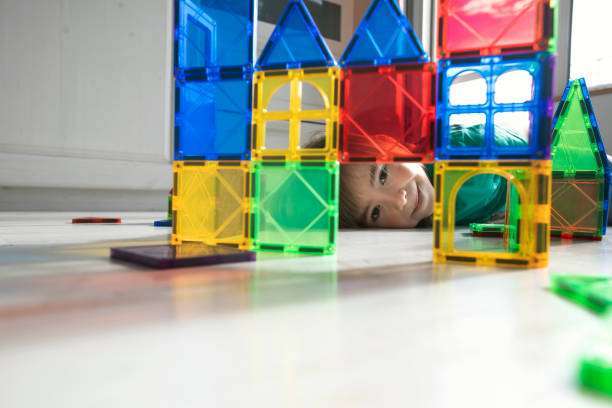
When the sun rises high in the sky, the light becomes intense, direct, and incredibly sharp, making midday the clearest and most obvious time to observe the color and structural details of magnetic tiles . The strong light penetrates the magnetic tiles , maximizing their saturation and even giving some colors a jewel-like brilliance—something that no artificial light source or the light of dawn or dusk can match.
What children typically see first under midday sunlight is the “explosion” of colors. Transparent red shines like a ruby, transparent yellow resembles a golden leaf, and transparent blue takes on a pure, deep-sea hue. The intense light makes the colors of magnetic tiles appear exceptionally real and vibrant, as if fully awakened and unmasked. This saturated color experience leaves a deep impression on a child’s visual memory, making them more willing to use different colors to create structures or combinations of patterns.
Another important characteristic of midday light is the “contraction” of shadows. Because the light shines almost perpendicularly, the shadows lie close to the underside of the magnetic tiles , their shapes extremely clear. This clarity helps children directly associate shadows with the shapes of objects. When they see that the shadow of a square is a square, and the shadow of a triangular piece is an acute or obtuse triangle, they can more easily understand the basic characteristics of geometric shapes. The shadows are no longer elongated and distorted, but return to the true proportions of the structure itself; this is an important stage for children to strengthen their geometric cognition and spatial concepts.
Midday light makes the refraction marks particularly noticeable. When strong light penetrates the edges of the transparent sheet, it creates bright, colored lines, like a naturally occurring outline of light around the magnetic tiles . This refraction often changes position or intensity as the child moves, helping them realize that light refraction depends not only on the object but also on the observer’s position. In science education, this experience is called “dynamic observation,” and it’s an important way to cultivate children’s ability to actively explore and change their perspective.
Furthermore, midday light has the most significant effect on the three-dimensional structures of magnetic tiles . Whether children are building towers, bridges, houses, or tilted shapes, the light creates different levels of shadow on these structures. When there are instabilities or a shift in the center of gravity within the structure, the shadow outlines will appear irregular, broken, or tilted, and children will intuitively sense that “something is wrong.” Although no one tells them this process, their vision is already conveying a message about structural stability. This is one of the important reasons why magnetic tiles can promote logical reasoning and structural thinking.
magnetic tiles under midday sunlight also produces a striking effect. Blue plus yellow creates a vibrant bright green, red plus blue creates a deep purple, and yellow plus red creates orange or amber. These color variations are no longer blurry but clearly discernible, greatly enhancing children’s understanding of color combinations. Many children will continue to experiment with different color combinations, thus entering a state of active exploration, spontaneously engaging in cross-disciplinary practice of science and art without parental or teacher instruction.
III. Evening Light and Shadow Experiment: The Serene Transmission of Light and the Diffusion of Shadows under Warm Light
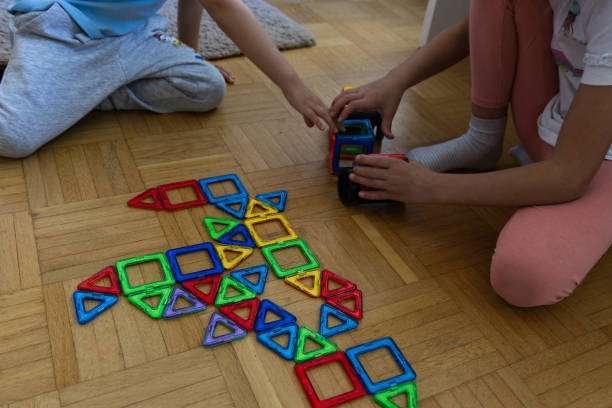
As the sun gradually approaches the horizon, the light begins to shift from cool white to warm orange and even reddish sunset light. This light is often referred to as the “golden hour,” a favorite subject for photographers, and for magnetic tiles , the light and shadow experiments during this time are equally captivating. The warm characteristics of the evening light give all the transparent tiles a serene, rich, and layered warm atmosphere, creating a completely different visual experience from the intense midday light.
magnetic tiles in the evening , they will first notice the “warming” of colors. Blue will lean towards a deep blue-purple, red will take on amber or reddish-brown hues, and yellow will become more golden, softer, and warmer. Warm light makes all colors appear heavier, as if they have transformed from light glass into warm gemstones. This visual change will spark children’s interest, because the same magnetic tile will appear completely different in the morning, at noon, and at dusk, thus making them realize that changes in light affect the appearance of colors, rather than the magnetic tiles themselves changing their color.
Evening light is dimmer than morning light, and the angle of the light is also lower. Therefore, shadows are not only elongated but also become rougher and have less defined edges. This is a typical example of a “diffuse shadow,” allowing children to observe that shadows are not always sharp lines but lose their boundaries as the light diffuses. Through this observation, children experience the blurring of light and shadow, which is crucial for their understanding of changes in light and shadow in the real world.
Evening light is also ideal for observing the interplay of light and shadow. If a child builds a three-dimensional magnetic tile structure , such as a tower or castle, the setting sun will shine in from one side, creating dappled light within the structure. Some transparent sections will let in warm light, while areas obscured by other structures will remain in shadow, forming a contrast between light and dark. This contrast allows children to truly experience the existence of “spatial layers” for the first time, a crucial element in spatial awareness training.
Furthermore, the effect of evening light on the refracted lines of magnetic tiles is quite unique. Under warm light, transparent sheets of different colors show more pronounced, warmer-colored refraction marks. These marks gradually weaken as the sun sets, turning the entire process into a dynamic, fading light and shadow performance. By observing the changes in light, children will realize that time is also a key factor in the changes of light and shadow, thus developing a sense of time through visual experience.

IV. Artificial Light Source Experiment: Controllable Observation and Structural Projection Laws under Constant Illumination
In the absence of natural light, artificial light sources have become another important way to observe magnetic tiles . Unlike natural light, artificial light has the characteristics of fixed direction, controllable brightness, and stable color temperature, making it very suitable for precise, repetitive, and experimental observations.
When a child places magnetic tiles under a lamp, the first noticeable change is the “fixed direction” of the shadow. This means the shadow’s trajectory depends entirely on the position of the light source and is unaffected by the sun’s movement. The child can easily control the length and direction of the shadow by changing the lamp’s angle, transforming the shadow’s movement from uncontrollable to “manipulable,” giving the child their first experience of “controlling light and shadow.” This experience is extremely valuable for developing a sense of manipulation.
Color mixing experiments conducted under artificial light often produce more uniform results than those conducted under natural light because the brightness of the light is stable and does not change due to cloud cover or the angle of sunlight. Children can observe the color changes after mixing, thus gaining a more precise understanding of color mixing principles. If warm-colored light is used, the mixed colors will lean towards a warm tone; if white light is used, the mixed colors will be closer to natural colors. This difference also helps children understand that the light source itself affects color presentation.
Artificial light sources also make the “laws of structural projection” easier to observe. For example, when a child builds a tilted structure, the shadow will accurately reflect its tilt angle; when the structure is not stable enough, the shadow will appear wobbly or have irregular edges. This shadow feedback also allows children to judge the sturdiness of the structure visually, which is an important form of structural cognitive training.
The most unique aspect of artificial light is its ability to create “multi-source projection.” When light is applied simultaneously from two angles, magnetic tiles will produce double or triple shadows, surprising children who will discover that there is more than one shadow. This phenomenon encourages children to ask questions, such as “Why are there two shadows?” and “Where do shadows come from?”, thus stimulating their interest in scientific exploration.
V. Conclusion
Magnetic tiles have a far richer relationship with light and shadow than ordinary toys. They are not only building tools, but also a natural optical experimental material, allowing children to spontaneously observe the direction of light, the length of shadows, color changes, color layering patterns, differences in light intensity, reflection and refraction, spatial layers, and temporal changes through play. The changes in light and shadow are not one-off experiences, but rather present completely different appearances each day, depending on the morning, noon, evening, and artificial light sources. This continuous change allows children to accumulate observational experience and develop a sensitivity to the details of the world.
For children’s development, magnetic tiles offer a unique path: they do not require electronic screens, yet provide dynamic and varied visual exploration; they do not require complex theories, yet allow children to experience real optical phenomena; they do not require mandatory teaching, yet naturally stimulate interest in science, art, and spatial cognition.
When children see the same magnetic tiles at different times and under different light sources , and yet see completely different worlds of light and shadow, they begin to understand a deeper truth: the world is changing every day, and their eyes, thoughts, and perceptions are constantly growing in the midst of these changes.