
Magnetic tiles are a fun and educational toy. Their transparent, colored panes and magnetic interlocking design stimulate children’s creativity and fine motor skills. Many parents may think it’s just an ordinary building toy, something children can simply “stack randomly” while playing. However, scientific observation and educational research show that children are actually engaged in a great deal of implicit learning while building magnetic tiles . Implicit learning refers to the cognitive, social, and behavioral skills that children unconsciously acquire. It often occurs quietly alongside play, yet plays a crucial role in a child’s development. Magnetic tiles are precisely such a toy, allowing children to subtly enhance multiple abilities through free play.
I. Cultivating Spatial Cognition and Three-Dimensional Thinking
Magnetic tiles allow children to piece them together in two-dimensional planes and also assemble them into three-dimensional structures. During play, children need to understand the arrangement, angle matching, and stability of the tiles. This process actually trains their spatial awareness and three-dimensional thinking.
By experimenting with different building methods, children gradually learn to judge which combinations can stand stably and which are prone to collapse. To build tall towers or complex shapes, children actively consider structural support points, center of gravity distribution, and interlayer balance. This not only enhances their spatial imagination but also lays the foundation for later learning of geometry, physics, and engineering. The transparent panes of magnetic tiles further increase the visual depth, allowing children to visually see the overlapping effects of different colors and layers, thus understanding perspective, spatial relationships, and spatial depth. This spatial awareness gained through play is a practical experience that is difficult to completely replace in the classroom.
II. Enhancing Color Recognition and Artistic Appreciation
magnetic tiles is their rich colors and transparent effect. When children are building, they naturally combine and match colors, which is actually a training in color recognition and artistic appreciation.
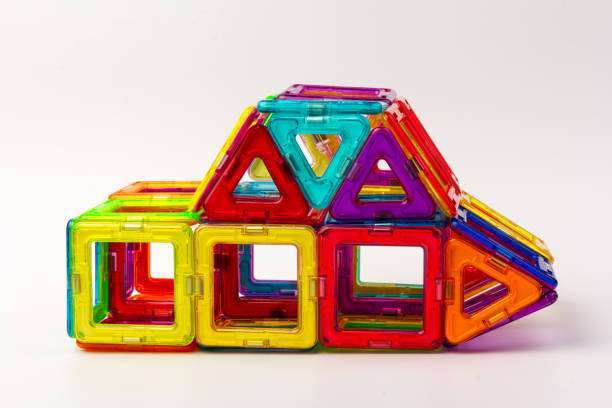
When children choose different colored magnetic tiles, they experiment with various combinations, observing how light changes color as it passes through the stained-glass window. The translucent design allows colors to overlap, creating new visual effects; for example, red and yellow combined might produce orange tones, while blue and yellow combined might produce green. This visual experiment helps children understand the basic principles of color mixing. Over time, children develop a greater sensitivity to color, better understand the aesthetics of color combinations, and gain direct experience for artistic activities such as painting and design. The implicit educational value of magnetic tiles in terms of aesthetics is subtly conveyed to children through this self-exploration and visual experimentation.
III. Developing Logical Thinking and Problem-Solving Skills
Playing with magnetic tiles is not just about randomly stacking them; it’s a process of continuous experimentation, problem-solving, and discovery. When children build towers or complex structures, they often encounter situations where tiles are unstable, layers are misaligned, or the structure collapses. To achieve their goal, children need to think about how to adjust the arrangement, rearrange the order, or choose a more stable combination.
In this process, children’s logical thinking skills are developed. They learn to analyze problems, compare solutions, predict outcomes, and correct mistakes through exploration. This combination of hands-on activities and logical reasoning is the best way to cultivate problem-solving abilities. Compared to simple paper exercises, magnetic tiles provide immediate feedback and a hands-on learning environment, allowing children to gradually master core logical thinking skills in a relaxed and enjoyable game.
IV. Development of Hand-Eye Coordination and Fine Motor Skills
Building magnetic tiles requires precise finger control to align, attract, and stack the tiles. This activity directly helps develop hand-eye coordination and fine motor skills. Through continuous practice, children’s hand muscle strength and dexterity improve, while their finger perception of space and force is enhanced.
For example, when a child tries to stack multiple magnetic tiles smoothly, they need to control the balance and weight of the tiles to prevent them from collapsing. This fine motor control training not only helps with building but also contributes to the development of writing, cutting, and drawing skills in daily life. Improved hand-eye coordination and fine motor skills are often a physical manifestation of improved cognitive abilities in children, and magnetic tiles provide a natural and fun training environment.
V. Stimulating Creativity and Imagination
magnetic tiles lies in their open-ended play style. There are no fixed patterns or rules; children are free to choose colors, shapes, and arrangements to create their own designs. This free exploration environment greatly stimulates children’s creativity and imagination.
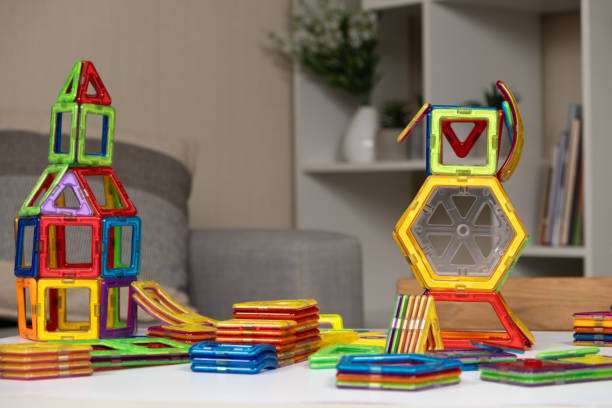
During play, children will try to build castles, houses, and bridges and even design unique abstract shapes. This creative act is not only an artistic expression but also a training ground for innovative thinking. Children learn to plan structures from scratch, combine colors, and consider balance and layering—all important components of innovative thinking. The transparent panes of the magnetic tiles increase the interplay of light and shadow, allowing children to observe the visual effects from different angles while creating, thereby further stimulating their aesthetic and creative abilities.
VI. Cultivating Cooperation Ability and Social Skills
Magnetic tiles aren’t limited to solo play; group building further enhances their educational value. During collaborative building, children need to communicate, negotiate, and divide tasks with their partners—this social interaction itself is an important form of implicit learning.
When children discuss building plans, they express their own ideas, listen to others’ opinions, and try to coordinate different solutions. This interaction helps improve communication skills, teamwork, and emotional management. At the same time, by completing a large project together, children experience a sense of accomplishment and responsibility, thereby enhancing their self-confidence and social adaptability. The open collaborative space provided by magnetic tiles allows children to naturally practice social skills through play—a subtle and stress-free learning experience.

VII. Cultivating Patience and Concentration
Building with magnetic tiles is a process that requires patience and focus. When children are building towers or complex structures, they need to concentrate, complete each layer step by step, and observe whether the structure is stable. If a tile easily slips or collapses, children need to adjust their strategy and patiently try again.
This process of repeated attempts and focused observation helps cultivate children’s sustained attention and resilience. When children successfully complete a complex project through effort, they not only gain a sense of satisfaction but also experience the importance of achieving results through focus and perseverance. This implicit learning has a positive impact on children’s academic performance and life habits, providing practical opportunities that are difficult to provide solely through classroom education.
VIII. Scientific knowledge, enlightenment, and exploration ability
Magnetic tiles incorporate a wealth of physics and engineering knowledge. Concepts such as magnetic attraction, center of gravity balance, and structural stability are understood and experienced unconsciously by children. By experimenting with different building methods, children can observe which structures are more stable and which arrangements are more prone to collapse, thus gaining a direct and intuitive understanding of physics.
Magnetic tiles allow children to learn experimental methods through play: trying, observing, analyzing, and adjusting. This exploratory ability is core to science learning and an important foundation for developing logical thinking and innovation. Parents can guide the children by asking appropriate questions, such as “What will happen if we put this magnetic tile on top?” or “Why did the tower collapse?” further transforming implicit learning into explicit knowledge.
IX. Conclusion
Magnetic tiles are not only brightly colored and versatile toys but also a vehicle for children’s implicit learning. Through free building, children’s spatial awareness, color perception, logical thinking, hand-eye coordination, creativity, social skills, patience, concentration, and scientific exploration abilities are all subtly enhanced. Magnetic tiles perfectly combine education and entertainment, allowing children to learn while playing and grow through creation.
Through observation and guidance, parents can not only help children better unleash their imagination but also transform the scientific knowledge, structural principles, color combinations, and teamwork involved in the building process into meaningful learning experiences. The true value of magnetic tiles lies not only in the various shapes they can create but also in the comprehensive development of children’s abilities through play. It allows children to subtly acquire multiple skills through independent exploration and creation in a relaxed and enjoyable play environment, laying a solid foundation for their future learning and life.
Every time a child builds, tries, or adjusts, it’s a silent learning process. Magnetic tiles transform toys into an extension of education, making play more than just entertainment; it becomes a comprehensive training ground for abilities. Through this edutainment approach, children can learn while playing and play while learning, truly achieving holistic development in creativity, cognitive skills, and social abilities.